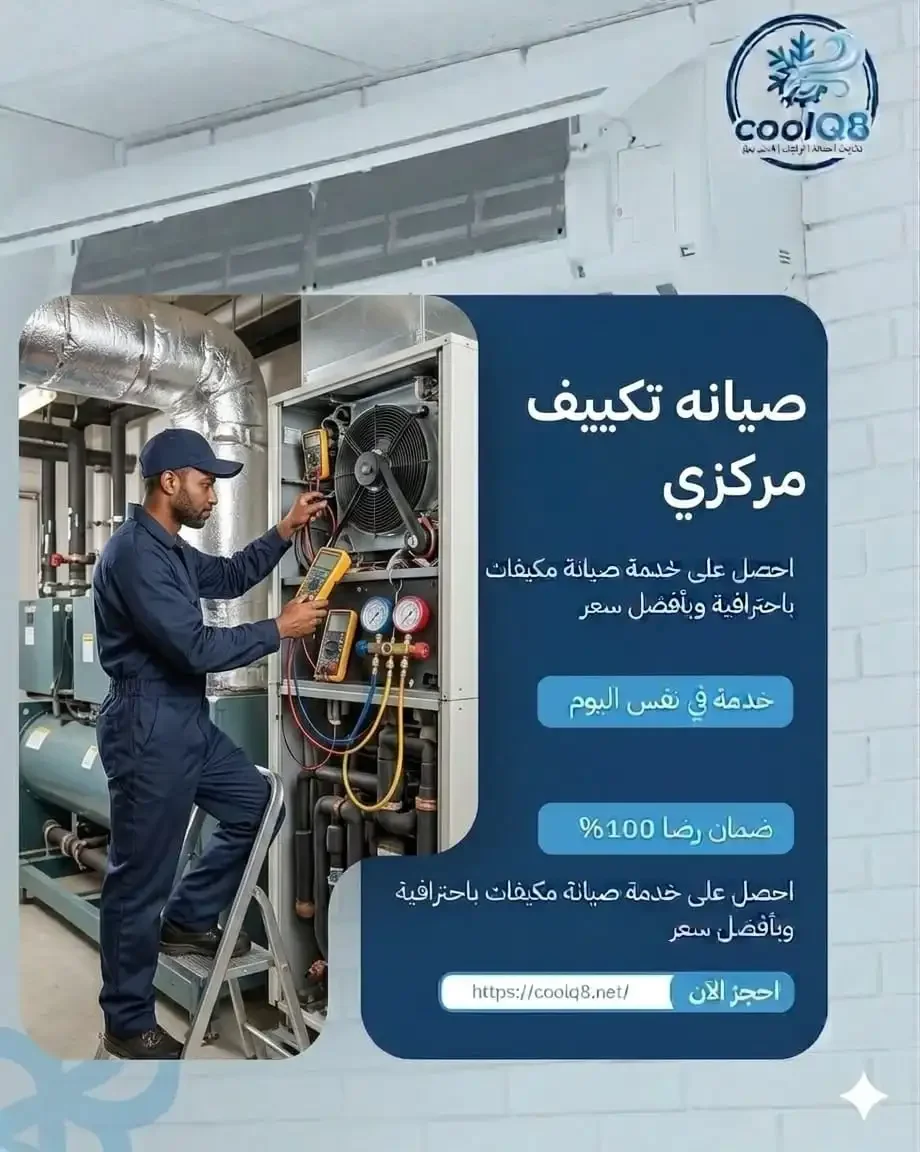
Signs Your Central AC Needs Urgent Maintenance
A central air conditioning system may continue operating even when a problem requires prompt attention, especially when a fault appears in one room while the remaining rooms stay cool. In Kuwait's hot climate, delaying action on certain problems may cause cooling to stop across a large area of a home or building. However, not every unusual observation requires the system to be switched off immediately. There is a difference between weak cooling that needs a prompt inspection and a burning smell that requires shutting down the system and contacting a specialist. This article explains which warning signs should not be ignored, how to determine their urgency, and what information helps a technician diagnose the problem without replacing working components or performing unnecessary work.
Central AC Maintenance

Central AC Maintenance differs from servicing an air conditioner that serves a single room because a problem may begin in one part of the system and then affect several areas of the building. Occupants of one room may notice weak airflow while the remaining rooms continue cooling normally, or all air outlets may stop providing the required cooling at the same time. This difference affects how the source of the problem is identified and how urgently intervention is needed.
When an unusual sign appears, the first step is to determine the extent of its impact. If the problem affects every room served by the system, the technician may need to examine shared components that influence operation. However, if it appears in only one room, it may be appropriate to begin by inspecting the airflow path or control components associated with that area, depending on the system's design.
Requesting urgent maintenance does not mean that every component needs to be dismantled or that comprehensive cleaning is required. The necessary work may be a targeted inspection to identify the cause of cooling failure, water leakage, or an unusual sound. Certain situations also require the system to be switched off before the technician arrives, particularly when there are signs of electrical danger or water leakage near electrical connections.
It is important for users not to keep changing control settings in the hope that the problem will disappear. If the system displays a fault code or shuts down automatically, it is better to record what appears on the control panel and explain when it happened to the technician without bypassing protective devices or repeatedly attempting to restart the equipment.
The following observations help determine the nature of the maintenance request:
- Identify the areas affected by the problem: If cooling is weak in every room served by the system, mention this when requesting service because the extent of the problem helps the technician choose an appropriate starting point for inspection instead of assuming that every air outlet requires a separate repair.
- Observe when the fault appears: The problem may begin immediately after the air conditioner starts, after a period of operation, or during extremely hot weather, and explaining this timing helps identify the operating conditions under which the symptom appears without treating it as conclusive evidence that a particular component is defective.
- Pay attention to unusual shutdowns: If the system stops suddenly or repeatedly shuts down while displaying a warning message, do not attempt to bypass its protective mechanisms or force it to continue operating. Leave the identification of the cause to a qualified technician.
- Be cautious about water near electricity: If water leakage reaches electrical components or surfaces containing electrical connections, avoid touching the affected area and switch off the system safely if this can be done without approaching the source of danger.
- Describe the problem instead of suggesting that a particular part should be replaced: Tell the technician about any sounds, smells, or changes in cooling performance you have noticed because an accurate diagnosis begins with understanding the symptoms and inspecting the associated components rather than replacing a part based on an unconfirmed assumption.
Warning Signs That Central AC Needs Maintenance
Warning Signs That Central AC Needs Maintenance can appear in different forms, and they do not all carry the same degree of urgency. A gradual decline in cooling may allow time to arrange a prompt inspection if there are no signs of danger, while a burning smell, smoke, or damaged electrical connections require the system to be switched off and specialist assistance requested without delay.
Other signs that deserve attention include water appearing in unusual locations or a new, loud sound coming from the equipment area. Users may notice that airflow from the outlets has suddenly become weak or that the system starts and then stops before achieving the required cooling. These symptoms do not identify the defective component on their own, but they indicate that the cause needs to be investigated.
It is important to distinguish between an unfamiliar smell when the system first starts and a clear burning smell. Not every smell should be treated as evidence of an electrical problem, but a burning smell or visible smoke requires the situation to be handled as a potential danger. The system should not be left running simply to see whether the smell disappears.
Similarly, sounds heard by the user may be associated with airflow through the distribution ducts, a mechanical component inside the air conditioning unit, or a part that is not properly secured. The location of the sound and when it occurs should therefore be identified rather than judging its source solely by how loud it is.
Signs that require appropriate action include the following:
- A burning smell or visible smoke: The system should be switched off safely, and users should not attempt to open covers or inspect wiring. A qualified specialist should identify the source of the problem before the equipment is allowed to operate again.
- Water leaking from the ceiling or near the unit: The source of the water should be identified, and its continued spread to furniture and surrounding surfaces should be limited whenever this can be done safely. An appropriate inspection should be requested without assuming that cleaning the drainpipe will resolve every possible cause of leakage.
- A loud rubbing or knocking sound that was not present before: A persistent new sound requires inspection to identify its source, particularly if it is accompanied by unusual vibration, instead of continuing to operate the equipment while waiting for the sound to disappear on its own.
- A sudden loss of cooling across a large area: If several rooms depend on the same system and lose cooling at the same time, it is appropriate to request an urgent inspection to identify a possible shared cause rather than attempting to address each room separately.
- Repeated circuit-breaker trips or a persistent warning: The breaker should not be reset repeatedly, and the warning should not be ignored because the system may have stopped operating in response to a problem that requires specialist diagnosis.
Central AC Faults
Central AC Faults do not always appear as a complete system shutdown. The equipment may continue operating while there is a problem with air distribution, a control component, or condensate drainage. The appropriate response varies according to the affected part and the extent to which the problem influences operation and safety.
When some rooms become warm while others remain cool, this does not necessarily mean that the compressor is defective or that the refrigerant charge is low. The problem may be associated with air distribution or a control component serving a particular area, depending on the system's design. However, if every area loses cooling at the same time, the inspection may need to focus on components shared across the system before moving on to components associated with individual rooms.
The appearance of water is also insufficient evidence that the drainage path is blocked. The problem may involve condensate collecting in an unsuitable location, a fault in a drainage component, or operating conditions that require a broader inspection. Repeatedly cleaning the pipe without identifying why the leakage returns may therefore allow the problem to continue.
A common mistake is requesting refrigerant charging immediately after noticing weak cooling. Reduced cooling is a symptom that can have several causes and is not sufficient evidence of a low refrigerant charge. If inspection confirms a leak in the refrigeration circuit, its location must be identified and the leak repaired before the appropriate action is taken according to the system's specifications.
The nature of the fault helps guide the inspection:
- Cooling failure in one area: The technician needs to determine whether the problem is associated with airflow reaching that area or with a control component serving it before inspecting shared parts for which there is no indication of a problem.
- Weak cooling across all areas: This requires reviewing operating conditions and shared components serving the affected spaces while avoiding the assumption that refrigerant is responsible before appropriate checks have been completed.
- Water leakage returning after a previous repair: The situation requires reviewing why the leakage keeps returning, the route taken by the water, and the associated components instead of automatically repeating the previous procedure without confirming that it addresses the current problem.
- The system stops while one of its components continues making a sound: The user should describe which parts appear to continue operating and which stop because differences in how fans and other components respond may help the technician select the appropriate inspection without independently proving the cause of the fault.
- A change in system performance after previous work: Providing the technician with the earlier maintenance or repair report is useful because it allows them to review what changed during operation without assuming that the previous work caused the new problem.
Central AC Inspection
Central AC Inspection begins by identifying the symptom that prompted the service request and then selecting the tests associated with it. A system that leaks water requires a different inspection approach from one that stops because of an electrical problem or loses cooling in one part of the building.
A specialist inspection does not mean dismantling every unit or performing tests unrelated to the complaint. The technician may begin by reviewing control settings, operating conditions, and the extent of the affected areas before moving on to the components indicated by those observations. Electrical work and inspections involving the refrigeration circuit must be performed by a qualified specialist in accordance with the manufacturer's instructions and applicable safety requirements.
Determining the urgency of the situation is also part of the inspection itself. The technician may decide that the system must remain switched off until a safety-related problem has been corrected, or determine that an operating fault can be repaired after the appropriate diagnosis has been completed.
- Inspect the extent of air distribution: Identifying rooms that receive normal airflow and those that are affected helps determine whether the problem is confined to one area or involves a shared part of the system.
- Review the control system's warning history: If a warning message or fault code appears, the technician can use it according to the model's manual without treating the code alone as a substitute for verifying the actual cause.
- Identify the source of noise or vibration: The sound should be linked to the component producing it and the time when it appears so an expensive part is not replaced simply because the user hears noise coming from the equipment area.
- Inspect the source and path of the water: Leakage requires identifying where water collects and how it reaches the affected location before selecting the appropriate cleaning or repair procedure.
- Explain inspection findings to the customer: The user should understand what has been confirmed, what work is required, and whether continued operation is safe instead of receiving only a general statement that comprehensive maintenance is necessary.
Urgent Central AC Maintenance

Urgent Central AC Maintenance becomes necessary when a symptom indicates a potential danger or when a fault affects cooling across a large area where suitable air conditioning cannot easily be dispensed with. However, the word urgent does not mean that every problem requires the same procedure. It means giving the situation a level of priority that matches its nature.
A burning smell, smoke, or water leakage near electrical components is different from a gradual decline in airflow inside a single room. In the first situation, safety takes priority, while the second requires an appropriate inspection appointment based on the severity of the problem and how the space is used.
If the building accommodates people who are particularly vulnerable to high temperatures, suitable arrangements should be made to protect their safety and comfort while waiting for the air conditioning to be repaired, without attempting to operate a system that shows signs of danger.
- When signs of electrical danger appear: Switch off the system safely if this can be done without approaching the source of danger, and contact a qualified specialist. Do not attempt to restart the equipment simply to confirm that the problem is still present.
- When cooling is lost throughout the building: Explain to the service provider that every area connected to the system has been affected so the request can be handled according to the actual extent of the problem rather than being recorded as limited cooling weakness in a single room.
- When water reaches the ceiling or furniture: Take whatever safe measures are possible to limit the damage and request identification of the source of the leak while avoiding opening equipment components or approaching electrical connections affected by water.
- When the system repeatedly shuts down: Record when the shutdown occurs and any messages displayed on the control panel, then leave the equipment switched off if there are signs of danger or warning instructions requiring this action.
- While waiting for the technician to arrive: Avoid repeatedly switching the equipment on and off or changing protective settings because these attempts may complicate the process of understanding the problem and will not correct its cause.
Central AC Problems
Some Central AC Problems initially appear minor because they affect only a limited part of the building. However, ignoring them may allow discomfort to continue or increase damage to the surrounding area. Conversely, users may assume that the system is defective when differences in room temperatures are actually related to the conditions of the rooms themselves.
A room exposed to direct sunlight may require more cooling than a shaded interior room. Air distribution may also vary according to the design of the air conditioning ducts and control components. The problem must therefore be evaluated according to actual conditions rather than treating every temperature difference as evidence of an urgent fault.
An unusual smell coming from air outlets or damp patches appearing around them requires the source of the problem to be identified, particularly if the symptom recurs or is accompanied by visible leakage. Moisture marks should not simply be covered with paint, and air fresheners should not be used as though they correct the underlying cause.
- A new and noticeable difference in room temperatures: If cooling distribution was previously balanced and then changed without a known adjustment in usage, it is appropriate to request an inspection to determine whether the problem involves air distribution, control settings, or another factor.
- An unusual smell that returns during operation: The nature of the smell and where it appears should be described to the technician so its source can be identified, while the system should be switched off if there is a burning smell or another clear sign of danger.
- Damp patches appearing around air outlets: The source of the moisture and the conditions under which it forms need to be identified rather than assuming that the problem is caused solely by leakage from the drainage pipe.
- Uneven airflow between rooms after changes to the building's interior: Changes to room layouts or how spaces are used may affect cooling requirements, so these changes should be reviewed before recommending repairs to components that are functioning normally.
- A problem that continues despite changes to control settings: If the situation does not improve after reviewing the settings that users are permitted to adjust, it is better to request an inspection rather than continuing to make random changes that do not identify the cause.
Weak Central AC Cooling
Weak Central AC Cooling is one of the most common symptoms that prompts a maintenance request, but it does not identify the component responsible for the problem on its own. Cooling may be affected by airflow, heat transfer, control components, or the heat load inside the building. The inspection approach varies according to the extent of the cooling weakness and when it appears.
If airflow from the outlets is weak, the problem differs from a situation in which a suitable amount of air is being delivered but the required cooling is not achieved. Users may also notice that the system cools adequately in the morning but struggles to reach the requested temperature during extremely hot weather. This requires a review of operating conditions and the heat load before concluding that a component is defective.
Reduced cooling alone should not be used to justify adding refrigerant or replacing the compressor. These procedures require a specialist diagnosis confirming that they are necessary according to the system's specifications.
- A weak volume of air coming from the outlets: This requires inspecting possible causes that obstruct airflow or affect its distribution instead of immediately beginning procedures involving the refrigeration circuit.
- Airflow is present but cooling is insufficient: This requires evaluating operating conditions, the building's circumstances, and the components involved in producing cooling before determining the required repair.
- Cooling performance declines only at certain times: Recording when the weakness appears and the conditions associated with it is useful because changes in heat load may affect performance even when no component is defective.
- One area is affected while the rest of the building remains cool: The components serving the affected area should be reviewed according to the system's design instead of assuming that a shared problem is affecting every room.
- A sudden decline in cooling accompanied by noise or a warning: These symptoms should be considered together and reported to the technician because the presence of more than one warning sign may change the urgency of the situation and the inspection approach.
Central AC Maintenance Service
When requesting a Central AC Maintenance Service because of an urgent warning sign, choosing an offer described as comprehensive maintenance is not enough. What matters most is that the scope of the service suits the problem and that the provider can explain the diagnostic steps and any work that may require additional approval.
If the complaint involves water leaking from the ceiling, the service request should describe where the leakage appears and how it relates to air conditioner operation. If the problem involves a loss of cooling, it is useful to explain which areas are affected and whether air is still flowing from the outlets.
Costs vary according to the type of system, the scope of inspection, access to the equipment, and the nature of the required repair. An accurate price therefore cannot be determined from a general description such as urgent central AC maintenance without knowing the details of the situation. A final repair quotation should also not be accepted before the cause has been diagnosed.
- Explain the nature of the problem when booking: Mention the main symptoms, where they appear, and how extensively they affect the building so the service provider can determine the appropriate type of inspection.
- Ask what is included in the visit price: You should know whether the price covers inspection and diagnosis only or includes specific work, and whether replacement parts or additional repairs are charged separately.
- Request an explanation of the proposed work: If the technician recommends replacing a component or performing specialist cleaning, it is appropriate to ask which inspection finding justifies the procedure instead of approving work that is unrelated to the problem.
- Make sure the service is suitable for the type of system: Central air conditioning systems differ in their components and how those components are accessed, so inspection and repair procedures should be compatible with the equipment's design and the manufacturer's instructions.
- Keep a description of the completed work: Documenting the cause of the problem and the procedure used to correct it helps with follow-up if the symptom returns later without assuming that the cause will be identical to the previous fault.
Central AC Repair
Central AC Repair becomes necessary when inspection confirms that a fault requires corrective work beyond ordinary monitoring or cleaning. Depending on the nature of the fault and the equipment's design, the repair may involve a mechanical or electrical component or part of the drainage or control system.
Component replacement should not begin based on symptoms alone. A loud sound may result from a component that is not properly secured, while another sound may require repair of a moving part. A cooling failure may also have several possible causes that cannot be distinguished without appropriate testing.
If the repair requires the air conditioning to be switched off across a large area of the building, it is useful to explain the expected extent of the interruption before work begins whenever possible. This allows users to make suitable arrangements for the space without receiving unsupported promises about how long the repair will take.
- Repair the cause confirmed by inspection: The work should be connected to the component responsible for the problem instead of making extensive changes simply because the central system contains several different parts.
- Review whether repair is possible before replacement: Some faults may be correctable without replacing an entire component, while other situations require replacement according to the component's condition and the system's specifications.
- Explain the cost of parts and labor: It is appropriate to separate the cost of the required component from repair labor and additional work so the customer understands what they are paying for before giving approval.
- Test the function affected by the fault: After the repair, the original problem should be checked under suitable testing conditions instead of merely confirming that the equipment has started operating again without reviewing the symptom that prompted the service request.
- Identify anything that requires later follow-up: If an observation does not require immediate repair, it should be explained separately so it is not confused with the problem that has already been corrected.
When Does Central AC Need Maintenance?
The answer to When Does Central AC Need Maintenance? depends on the nature of the warning sign and how it affects safety and cooling. Some symptoms require the system to be switched off and specialist intervention requested, while others allow a prompt inspection appointment to be arranged without ignoring the problem or postponing it indefinitely.
It is useful for users to distinguish between an emergency, an operating problem, and an observation that requires monitoring. A burning smell is not the same as a limited temperature difference in a room exposed to sunlight, and water leakage near electrical connections is not the same as a minor change in airflow distribution.
There is no single waiting period that is suitable for every building. The need for cooling may be more urgent in a location occupied by people who do not tolerate high temperatures well, but this does not justify operating a system that shows signs of danger.
- Immediate intervention and safe shutdown are required when a danger appears: This includes a burning smell, smoke, visible damage to electrical connections, or water leakage near electrical components. Users should avoid approaching the source of danger or attempting repairs themselves.
- A prompt inspection is needed when cooling is significantly reduced: If a large area of the building no longer receives adequate cooling, service should be requested and the extent of the problem explained so the situation can be assessed according to the needs of the space.
- Diagnosis is needed when the system repeatedly stops operating: Repeated shutdowns or warning messages should not be bypassed by continuously restarting the equipment. The cause must be identified according to the system's instructions.
- Justified follow-up is needed when a limited change appears: If the difference is minor and there are no signs of danger, the circumstances under which it appears can be recorded and an appropriate inspection requested if the problem continues or becomes more noticeable.
- A further inspection is needed after a repair that did not resolve the complaint: If the same symptom returns, the technician should be informed about the previous work and asked to reassess the cause instead of automatically repeating the same procedure.
How Can You Assess the Severity of a Warning Sign Before the Central AC Technician Arrives?
The purpose of assessing warning signs before the technician arrives is not to diagnose the fault yourself. It is to make a safe decision about whether the equipment should continue operating and to provide a description that helps the situation be handled appropriately. You can observe what appears on the control panel, identify the affected rooms, and describe sounds or smells from a safe location without opening covers, accessing equipment, or touching electrical connections.
If the warning sign indicates a possible electrical danger or smoke, action should not be delayed simply because the system is still providing cooling. However, if the problem is limited cooling weakness without signs of danger, arranging an inspection to identify the cause may be appropriate while considering the needs of the people occupying the space.
Avoid making repair decisions based on assumptions such as the need to replace the compressor or add refrigerant before an inspection. The information observed by the user helps with diagnosis, but it cannot replace the required technical tests.
- Prioritize safety over continued cooling: If a burning smell, smoke, or water near electrical components appears, move away from the source of danger, switch off the system safely if possible without putting yourself at risk, and request specialist assistance.
- Determine whether the problem is widespread or limited to one area: Knowing whether every room is affected or the problem is confined to one area helps the technician understand the extent of the situation before beginning the inspection.
- Record the warning sign without trying to reproduce it: If a sudden shutdown occurs or a warning appears, do not repeatedly restart the system to make the fault appear again. Simply describe what happened and when it occurred.
- Do not open covers or work on internal components: The equipment may contain electrical connections, moving parts, and components that require special technical procedures, so inspection and repair must be left to a qualified specialist.
- Request a clear report after diagnosis: The report should explain the cause that has been verified, the work required, and whether operation is safe before and after repair so your approval is based on specific information.
Conclusion
Urgent central AC maintenance becomes necessary when a problem goes beyond a minor temperature difference and begins to affect cooling, water drainage, operating stability, or safety. Burning smells, smoke, and visible electrical problems require immediate attention and safe shutdown, while other performance problems require an inspection whose priority depends on their severity and the extent of their impact.
A single symptom is not enough to identify the defective component because a central air conditioning system contains shared components as well as others that may serve particular areas. Accurately describing the problem and choosing an inspection related to it therefore helps avoid replacing working components or repeating procedures that do not address the cause.
If you notice an unusual warning sign in the central air conditioning system of your home or building in Kuwait, do not ignore it or attempt to repair internal components yourself. Identify the nature of the symptom and how extensively it affects the building, then request an appropriate technical service while giving safety priority whenever a sign of danger appears.
Frequently Asked Questions
What are the main signs that central AC needs urgent maintenance?
Warning signs include a burning smell, visible smoke, water leakage near electrical components, a sudden loss of cooling across a large area, or repeated system shutdowns accompanied by warning messages. The degree of urgency varies according to the nature of the symptom and its effect on safety and operation.
Should central AC be switched off when a burning smell appears?
Yes. The system should be switched off safely if this can be done without approaching the source of danger, and an inspection by a qualified specialist should be requested. It should not be restarted before the cause of the smell has been identified and corrected.
Does weak cooling in one room mean the entire central AC system is defective?
Not necessarily. The problem may be associated with air distribution, control of a particular area, or the room's own conditions. Identifying the cause requires an inspection suited to the system's design and the extent of the problem.
Does water leaking from a room's ceiling require urgent maintenance?
The source of the leak needs to be identified and addressed before damage continues. The situation becomes more dangerous if water reaches electrical connections or equipment that may be affected by it. Not every leak should be assumed to result from a blocked drainage path.
Does a loud sound from the central AC unit mean the compressor is defective?
The source of a sound cannot be determined from its volume alone. It may be associated with a fan, a moving part, or the mounting of a component. The location and nature of the sound must be identified before any repair or replacement is recommended.
Can central AC be operated if it repeatedly trips the circuit breaker?
The circuit breaker should not be reset repeatedly, and the system should not be forced to operate. Inspection and correction of the cause must be left to a qualified specialist because repeated tripping may indicate a problem that requires safe handling.
Does weak central AC cooling require immediate refrigerant charging?
No. Weak cooling may result from several different causes and is not sufficient evidence of a low refrigerant charge. An appropriate diagnosis must be performed, and the cause of any confirmed leak must be identified before refrigerant is handled according to the system's specifications.
How do I choose a suitable central AC maintenance service when an urgent fault appears?
Explain the symptoms and the extent of the affected areas, and ask what inspection work is included in the visit and how the cost of additional repairs will be determined. The service should be suitable for the type of system and should rely on diagnosis before components are replaced.
Does urgent central AC maintenance cost more than ordinary repair?
The cost may vary according to the type of system, the scope of inspection, the nature of the problem, and the work and replacement parts required. An accurate price cannot be determined, and a fixed additional charge should not be assumed without knowing the service details and the quotation provided.
What should I do if the fault returns after central AC repair?
Provide the technician with an accurate description of the current symptom and the previous work report if available, and request a reassessment of the cause instead of automatically repeating the same repair. The original problem may still be present, or a different problem requiring a separate diagnosis may have developed.