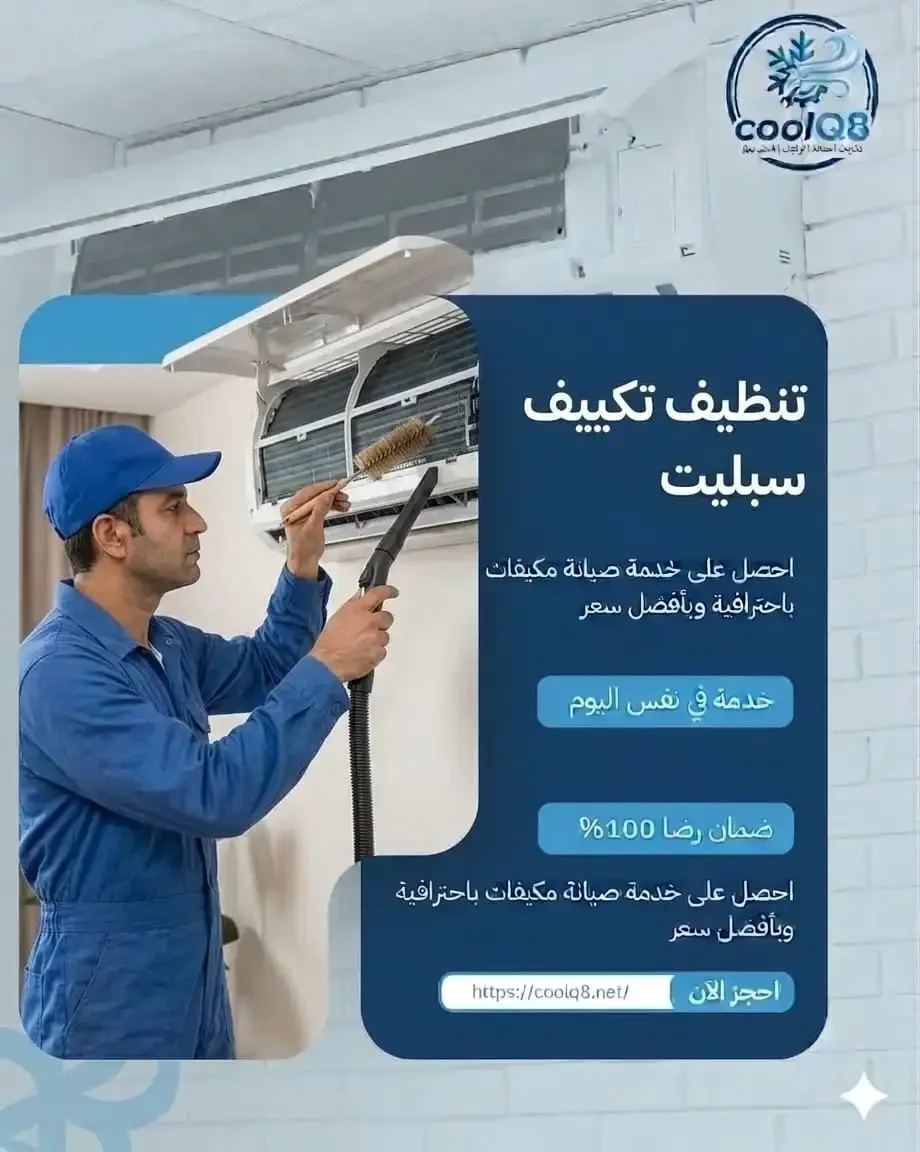
When Does a Split AC Need Professional Cleaning
You may clean your split air conditioner's filter regularly and still notice that the airflow has become weaker or that an unusual smell appears when you turn it on. This raises an important question: does the air conditioner need professional cleaning, or does the problem require a different technical inspection? The answer does not depend on how long the unit has been used alone, because dust accumulation inside it is affected by its installation location, the conditions inside the home, how frequently it operates, and how it is maintained. In Kuwait, some air conditioners may be exposed to more dust than others, but this does not mean that every unit needs deep cleaning at a fixed interval. This article explains the signs that call for specialist cleaning, the difference between cleaning the filter and cleaning internal components, and how to choose the appropriate service without exposing the air conditioner to damage.
Split AC Cleaning

Split AC cleaning begins with understanding the difference between components that users can maintain according to the equipment's instructions and internal components that require a qualified technician. The manuals for some models may allow users to remove and clean the filters in a specified way, but this does not mean that they can safely wash the cooling coil or internal fan or remove covers to access electrical connections.
The air conditioner's cleaning requirements also depend on its actual condition. The filter may be dirty while the internal components remain in suitable condition, or the filter may appear clean despite deposits inside the unit that affect airflow or cause an unusual smell. The cleanliness of the air conditioner therefore cannot be judged solely by the appearance of its filter.
Imagine a bedroom where the air conditioner is used every day and its filter is cleaned according to the equipment's instructions. After some time, the occupants notice that the airflow coming from the unit has become weaker than usual. In this situation, it is appropriate to inspect the condition of components associated with airflow instead of repeatedly cleaning the filter alone or assuming that the air conditioner needs refrigerant charging.
However, if the air conditioner operates normally and there are no visible deposits or observations requiring intervention, internal washing should not be considered necessary simply because a certain amount of time has passed. The manufacturer's instructions and the equipment's condition remain the basis for determining appropriate maintenance procedures.
The following observations help determine the required scope of cleaning:
- A dirty filter while the air conditioner continues operating normally: The model's instructions can be reviewed to establish the filter-cleaning method permitted for users, after which performance can be reassessed once the filter has been allowed to dry in the specified way before considering internal cleaning for which there is no clear need.
- Deposits behind components that users can access: If dirt appears inside the unit in locations not covered by cleaning procedures permitted for users, it is better to request a specialist inspection instead of inserting tools or spraying water inside the equipment without knowing where sensitive components are located.
- Weak airflow despite regular filter maintenance: This may require an inspection of the internal fan, cooling coil, and airflow path according to the air conditioner's design, without assuming that dirt is the only cause before checking the condition of components associated with the problem.
- An unusual smell when the unit is switched on: The nature of the smell and when it appears should be noted because some odors may be associated with deposits or moisture inside the equipment, while a burning smell requires the system to be switched off safely and a technical inspection to be requested instead of treating it as an ordinary cleaning problem.
- Uncertainty about previous cleaning work: If there is no clear record of the air conditioner's maintenance, it is appropriate to assess its current condition and identify the components that actually need cleaning instead of automatically agreeing to wash every component.
Professional Split AC Cleaning
Professional split AC cleaning means choosing a cleaning method that suits the air conditioner's design and the condition of its components while protecting parts that must not be exposed to water or cleaning products. The professionalism of a service is not measured by the amount of water used or the number of components the technician removes, but by the ability to identify where dirt has accumulated and select an appropriate procedure without creating a new problem.
One air conditioner may need targeted cleaning of the internal fan because visible deposits have accumulated on it, while another may need attention to the cooling coil or an inspection of the water drainage path. It would be a mistake to treat both situations in the same way simply because both units are split air conditioners. An unusual smell or weak cooling also does not, by itself, prove that deep cleaning will resolve the problem.
Before starting work, the technician should explain which components will be cleaned, how they will be accessed, and whether the service requires certain parts to be removed. If cleaning involves the use of water, appropriate precautions must be taken to protect electrical connections, electronic control boards, and surrounding interior finishes according to the model's instructions.
It is also important not to confuse cleaning with repair. If an inspection reveals a fault in the unit's fan, a water drainage problem, or an electrical malfunction, the equipment may need a separate technical procedure that cannot be replaced by washing.
The characteristics of a professional service include the following:
- Identifying where dirt has accumulated before choosing a cleaning method: The scope of work should be based on the condition of internal components rather than using one approach for every unit, because an air conditioner that only needs its filter cleaned is different from equipment with obvious internal deposits.
- Protecting electrical and electronic components: Internal work must be carried out by a specialist who understands the locations of sensitive components, the requirements for disconnecting electrical power, and safe access procedures, without spraying water randomly inside the unit or assuming that covering one visible component alone provides sufficient protection.
- Choosing products suitable for the air conditioner: Cleaning products and methods should be compatible with the manufacturer's instructions because using an unsuitable product or leaving its residue inside the equipment may create a problem instead of improving its condition.
- Explaining work that requires internal components to be removed: If accessing the fan or another component requires part of the unit to be removed, it is appropriate to explain this beforehand and clarify whether the procedure is included in the service price.
- Reviewing the equipment's condition after cleaning is complete: The technician should confirm that components handled during cleaning have been reassembled correctly and review operation using appropriate procedures, while explaining any problem unrelated to dirt that became apparent during the work.
When Does a Split AC Need Cleaning?
The answer to when a split AC needs cleaning does not depend solely on the number of months since the last service visit. A unit installed in a room near a source of dust may become dirty faster than another air conditioner operating in a different environment, and using the equipment for extended periods may make monitoring its condition more important. However, setting a fixed schedule for deep cleaning without considering the condition of its components may lead to a service that the air conditioner does not need.
It is useful to distinguish between an observation that calls for cleaning and a symptom that requires diagnosis. If obvious deposits appear on the internal fan or on components that can be viewed safely, specialist cleaning may be appropriate after the condition has been assessed. However, if the air conditioner suddenly stops cooling or displays a fault message, dirt should not automatically be assumed to be the cause.
An unusual smell also does not necessarily mean that the equipment needs comprehensive washing. It may be necessary to identify the source of the odor and check for moisture or deposits inside the unit, while remembering that smells associated with burning or unusual overheating must be treated as safety warnings rather than ordinary cleaning requests.
The need for specialist assessment becomes clearer when a symptom quickly returns after the filter has been cleaned correctly or when internal dirt cannot be reached by the user without removing parts of the air conditioner.
The following situations can help determine when to request service:
- Dirt accumulating on internal components that are difficult to access: If obvious deposits can be seen behind the cover or on the fan without dismantling the equipment, it is appropriate to request an assessment of how these components should be cleaned instead of trying to reach them with a long tool that may damage the equipment.
- Airflow remains weak after the filter has been cleaned: The equipment deserves an inspection to establish whether internal deposits are obstructing airflow or whether another technical cause is involved, because repeatedly washing the filter will not address a problem located elsewhere.
- An unusual smell returns when the air conditioner is switched on: It is better to identify the nature and source of the smell before selecting a service, because a particular component may need cleaning or a moisture problem may require attention, while a burning smell requires operation to stop and a specialist inspection to be requested.
- Visible dirt associated with water drainage: If residue or deposits appear in drainage components that can be inspected safely, their condition should be assessed and an appropriate procedure identified instead of pouring cleaning products randomly into the equipment.
- Operating conditions have changed since the previous period: If the air conditioner begins operating for longer periods or the room becomes more exposed to dust, it may be appropriate to review the condition of the filters and internal components according to the equipment's instructions without automatically treating the changed conditions as a reason for comprehensive washing.
Washing a Split Air Conditioner
The expression washing a split air conditioner is commonly used to describe cleaning internal components with water or products intended for that purpose, but it does not mean that every part of the air conditioner can be washed in the same way. The indoor unit contains electrical and electronic components, mechanical parts, and water drainage paths, each of which has different cleaning requirements.
Washing may be appropriate for removing deposits from components that the equipment's instructions allow to be cleaned in this way, while other components require a different method or must not be exposed to water at all. The service should therefore not be selected solely on the basis of demonstrations involving large amounts of water, but according to whether the procedure suits the air conditioner and the condition of its components.
A common mistake is believing that higher water pressure means better cleaning. Using unsuitable pressure may damage sensitive components or push water into areas not designed to receive it. The walls, furniture, and flooring surrounding the unit should also be protected from the water used during the work.
- Identify which components can be washed according to their design: The technician must understand which parts can be cleaned with water and which require protection or a different method according to the model's instructions instead of exposing the entire indoor unit to water without distinction.
- Choose water pressure suitable for the components: Pressure that may affect delicate parts or cause water to enter areas not designed to receive it should not be used, because the objective is to remove dirt without causing new damage.
- Protect the area surrounding the unit: It is appropriate to prepare a suitable method for collecting water and protecting the wall, furniture, and flooring before work begins, particularly when the air conditioner is installed above equipment or interior finishes that are sensitive to moisture.
- Avoid cleaning products with unknown effects: Products should be confirmed as suitable for the surfaces and components they will contact, and their correct application methods should be followed instead of relying on a strong smell or excessive foam as evidence of cleaning quality.
- Confirm that the work is complete before restarting the equipment: The specialist must review the condition of the components that were cleaned and reassembled, along with the drying and safety requirements specified in the equipment's instructions, instead of switching on the air conditioner immediately simply because water spraying has finished.
Cleaning a Split AC Unit

Cleaning a split AC unit requires identifying which part of the equipment is being discussed because a split air conditioner consists of an indoor unit and an outdoor unit, and their cleaning requirements and access methods are not the same. A homeowner may request cleaning of the entire air conditioner even though the problem is associated only with the indoor unit, or may notice visible dirt on the outdoor unit without any reason to clean every part of the equipment.
For the indoor unit, cleaning work relates to the condition of the filters, fan, cooling coil, and components associated with collecting and draining water according to the model's design. The outdoor unit requires a different assessment that considers its installation location, surrounding ventilation, and the condition of components that may be exposed to dust and outdoor conditions.
The outdoor unit should not be washed randomly, particularly if it is installed in an elevated location or somewhere that is difficult to access safely. Cleaning the indoor unit also does not automatically require comprehensive cleaning of the outdoor unit during the same visit.
- Identify which unit is associated with the complaint: If an odor appearing inside the room is the reason for requesting service, it is appropriate to direct the inspection toward its source instead of assuming that cleaning the outdoor unit will resolve it.
- Review the indoor unit's condition according to its design: Some models may require special procedures to access the fan or cooling coil, so their instructions should be followed and covers or internal components should not be removed randomly.
- Assess dirt on the outdoor unit separately: It should be established whether dust is affecting components that require attention according to the equipment's instructions, without treating dust on the outer casing as sufficient evidence that comprehensive washing is needed.
- Consider safe access to the installation location: If the outdoor unit is mounted on an elevated building facade or in a confined location, the access method must suit the site conditions instead of exposing the worker or household members to danger for cleaning that is not urgent.
- Clarify which units are included in the service: It is better to know whether the price covers cleaning the indoor unit only or includes an assessment of the outdoor unit and specific work on it so that disagreements about the scope of work do not arise after the visit has begun.
Split AC Cleaning in Kuwait
When requesting split AC cleaning in Kuwait, it is important to consider the conditions in which the equipment operates instead of assuming that every air conditioner becomes dirty at the same rate. The amount of dust entering a home may vary according to its location, how windows and ventilation are used, the condition of the filters, and the air conditioner's operating hours.
In some homes, filters may need more frequent attention during dusty periods, but this does not mean that every dust storm requires the indoor unit to undergo deep washing. The decision depends on the equipment's condition, the manufacturer's instructions, and the presence of actual signs that call for specialist cleaning.
When comparing service offers, it is important to know whether the price covers filter cleaning, cleaning specific internal components, or washing the unit using a method appropriate for its model. Different offers may use the same service name even though the scope of work varies considerably.
- Assess room conditions instead of relying solely on the season: The cleaning requirements of an air conditioner in a room where windows are opened frequently may differ from those of a unit operating in a room less exposed to dust, so the decision to clean should reflect the equipment's actual condition.
- Ask about the scope of service before comparing prices: The components to be cleaned should be identified, along with whether the service includes the indoor unit only or additional procedures, because a lower price does not necessarily mean that two offers include the same work.
- Identify access requirements for the unit: If the air conditioner is installed above fixed furniture or in a location that is difficult to reach, it is appropriate to inform the service provider beforehand so that a suitable working method can be determined without unexpected difficulties during the visit.
- Do not accept additional services unrelated to dirt: Refrigerant charging or replacement of components should not automatically be considered part of split AC cleaning, and any additional procedure must be based on a separate diagnosis explaining why it is necessary.
- Request a clear description of the completed work: Knowing which components were cleaned and what observations arose during the visit helps determine an appropriate future maintenance schedule without repeating internal cleaning that the equipment does not need.
Deep Cleaning a Split AC
Deep cleaning a split AC means reaching deposits that are not addressed by filter cleaning or ordinary surface maintenance. This may include specific internal components depending on the equipment's design and the condition of the dirt, but it does not mean that the entire air conditioner must be dismantled or that every component inside it must be washed.
The importance of assessment before deep cleaning becomes clear when deposits appear on the internal fan or in areas that are difficult to access safely. In this situation, the specialist should determine the appropriate access method and whether certain parts need to be removed, while considering whether they can be reassembled correctly.
Deep cleaning is not a guaranteed solution to every cooling problem or unusual smell. If the complaint continues after the dirt has been removed, the cause may be associated with another factor requiring a separate inspection.
- Identify the reason deep cleaning is needed: There should be a clear observation involving internal deposits or a need established by inspection instead of choosing the service simply because its name suggests that it is more comprehensive.
- Understand which components the technician will access: It should be clarified whether the work includes the fan, cooling coil, or other specific components because the term deep cleaning does not represent an identical scope of work among all service providers.
- Review whether certain components need to be removed: If cleaning requires internal parts to be removed, this should be done according to the model's instructions by a specialist who can reassemble them without affecting the equipment's operation.
- Avoid excessive use of water and cleaning chemicals: The amount and application method should suit the nature of the dirt and the components involved because using more cleaning products does not prove that the result will be better.
- Evaluate the cleaning result against the original problem: If the objective was to address weak airflow or remove visible deposits, the outcome should be reviewed after the work instead of treating the completion of washing as proof that a complaint whose cause was not confirmed has been resolved.
Signs of a Dirty Split AC
Signs of a dirty split AC help determine when the condition of the equipment's components needs to be inspected, but they are not sufficient on their own to confirm that cleaning is the solution. Weak airflow caused by accumulated dirt may resemble symptoms associated with the fan or other operating problems, and an unusual smell may originate from a source inside the room rather than the air conditioner itself.
It is better to observe changes compared with the equipment's usual condition. If airflow was previously normal and then gradually became weaker, or deposits appeared in locations that can be viewed without dismantling the equipment, it may be appropriate to assess whether specialist cleaning is needed.
- Obvious deposits on the filter: These indicate a need to review the maintenance method specified in the equipment's manual, but they do not, by themselves, prove that the fan or cooling coil needs internal washing.
- Dirt appearing on visible components behind the air outlet: This observation may call for a specialist inspection to establish the extent of the deposits and the appropriate way to remove them without inserting tools between moving parts.
- A gradual change in airflow: Dirt may be one possible cause, but the condition of the filters and components associated with airflow should be evaluated before deciding on cleaning.
- An unusual smell when operation begins: The source and nature of the odor deserve investigation, while a burning smell or smoke must not be treated as ordinary signs of dirt.
- Residue or deposits in areas where water collects: These components may require appropriate inspection and cleaning according to the unit's design, while the cause of any leakage must be identified instead of simply removing visible residue.
Choosing a Split AC Cleaning Service

When choosing a split AC cleaning service, asking about the price or duration of the visit alone is not enough. What matters most is understanding what the service will actually include and whether it suits the air conditioner's condition. One unit may only need filter cleaning according to the instructions intended for users, while another may require specialist intervention to reach internal deposits.
It is appropriate to describe the problem to the service provider before booking. If the reason for requesting service is an odor, weak airflow, or visible deposits, this helps determine whether cleaning is required or whether a technical inspection should come first. The cost of any additional work should also be agreed upon before it is performed.
- Choose a service that begins by assessing the equipment's condition: An initial inspection helps identify which components need cleaning instead of performing a fixed list of procedures without considering where dirt has accumulated.
- Request an explanation of how the surrounding area and air conditioner will be protected: It is important to understand how water and cleaning products will be handled and how sensitive components and surrounding interior finishes will be protected, particularly when cleaning a unit installed inside a furnished room.
- Understand what is included in the basic price: It is better to clarify whether the service covers cleaning the filter, fan, and specific internal components or is limited to certain procedures so that different offers can be compared fairly.
- Do not agree to an additional repair without a diagnosis: If a technical problem becomes apparent during cleaning, it should be explained and the cost of correcting it should be identified separately instead of adding work that the homeowner has not approved in advance.
- Obtain an explanation after the visit is complete: It should be clear which components were cleaned and whether any observations require follow-up, without presenting cleaning as a guarantee that future faults will not occur.
Routine Split AC Cleaning
Routine split AC cleaning helps monitor the condition of components exposed to dust accumulation during use, but it does not mean performing comprehensive internal washing at every scheduled appointment. Maintenance procedures permitted for users may be required at intervals different from those for specialist cleaning, and the air conditioner's needs also change according to the conditions of the location and its operating hours.
It is preferable to rely on the manufacturer's instructions and actual observations during use instead of applying one fixed schedule to every split air conditioner. If the equipment operates normally and there are no deposits requiring intervention, appropriate monitoring may be better than repeating internal cleaning without a clear need.
- Follow the filter maintenance requirements for the specific model: The method and timing of filter maintenance should be reviewed according to the equipment's manual and operating conditions instead of assuming that every filter can be washed or requires the same procedure.
- Connect internal cleaning to the condition of the components: Deep washing should not automatically be booked with every routine maintenance visit. Its necessity should be established when deposits or observations make specialist cleaning appropriate.
- Record the date and scope of the most recent cleaning: Knowing which components were cleaned previously helps avoid repeating the same work without a reason and helps direct the inspection if a new complaint appears.
- Review the equipment's condition when room conditions change: If the location becomes more exposed to dust or the air conditioner's operating hours increase, it may be appropriate to monitor the filters and the unit's condition more frequently according to the equipment's instructions.
- Do not postpone a clear problem until the next cleaning appointment: If a burning smell, water leakage near electrical components, or an unusual shutdown occurs, the situation must be addressed according to its nature instead of waiting for the routine cleaning visit.
How Can You Tell Whether Your Split AC Needs Cleaning or Repair?
A homeowner may request professional cleaning after noticing weak cooling or an unusual smell, only to discover that dirt is not the main cause. The most important step before selecting a service is therefore to distinguish between signs suggesting accumulated dirt and symptoms that may require a different technical inspection.
If obvious deposits appear inside the unit along with a gradual decline in airflow, cleaning the affected components may be appropriate after their condition has been assessed. However, if the air conditioner suddenly stops, no longer starts, or displays a fault message, identifying the cause of the problem takes priority over booking deep washing in the hope that it will restore operation.
Both situations may also occur in the same air conditioner. It may need a dirty component cleaned and another component repaired. In that case, the scope and cost of each procedure should be explained instead of treating cleaning as a substitute for diagnosis or repair.
- If the problem involves visible deposits while operation remains normal: It is appropriate to assess the dirty components and determine how they should be cleaned without extending the scope of service to components for which there is no clear need.
- If the air conditioner does not operate or repeatedly shuts down: A technical inspection should be requested to identify the cause of the shutdown, and repeatedly restarting the equipment or treating filter cleaning as a sufficient solution to an undiagnosed problem should be avoided.
- If a burning smell or smoke appears: Operation must be stopped safely if this can be done without exposure to danger, and assistance from a specialist should be requested because these warning signs must not be addressed by applying cleaning products or washing the unit.
- If water leakage continues: The source of the water and the condition of the drainage path and associated components must be identified. Cleaning may form part of the corrective procedure if its necessity is confirmed, but it is not an automatic solution to every leak.
- If the service provider proposes comprehensive cleaning along with additional repairs: An explanation of the problem addressed by each procedure and its cost should be requested before approval so that you do not pay for repeated work or procedures unrelated to the original complaint.
Conclusion
A split air conditioner needs professional cleaning when internal deposits appear that cannot be addressed through maintenance procedures permitted for users, or when an inspection confirms that dirt is affecting airflow or the condition of a particular component inside the unit. However, weak cooling, unusual smells, and water leakage do not automatically mean that deep washing is the solution, because these symptoms may require a different diagnosis depending on their causes.
The appropriate service is not the one that uses the greatest amount of water or removes the largest number of components. It is the service that identifies where dirt has accumulated, chooses a cleaning method compatible with the air conditioner's design, and protects its components and the surrounding area.
If you notice a change in the performance of your split air conditioner at home in Kuwait, begin by reviewing the maintenance procedures permitted under the equipment's instructions. Then request a specialist assessment when the problem is inside the unit or continues despite filter cleaning. This approach helps you choose cleaning that the air conditioner actually needs without paying additional costs or exposing it to unsuitable procedures.
Frequently Asked Questions
When does a split air conditioner need professional cleaning?
It may need professional cleaning when internal deposits are difficult to reach safely or when an inspection confirms that dirt is affecting airflow or the condition of a particular component. The scope of cleaning must be determined according to the equipment's design and actual condition.
Does cleaning the split AC filter eliminate the need for professional cleaning?
Cleaning the filter according to the equipment's instructions may be sufficient when dirt is limited to the filter and no other problem exists. However, internal deposits or symptoms that continue after filter maintenance may require a specialist assessment.
Does weak split AC cooling mean that the unit needs washing?
Not necessarily. Weak cooling may be associated with dirt, technical problems, or other operating conditions, so the cause should be identified before choosing washing or any additional procedure.
Can the indoor unit of a split AC be washed with water?
Certain components can be cleaned using methods involving water if these methods are suitable for the equipment's design and instructions. However, all components must not be exposed to water randomly, particularly electrical and electronic parts.
Is an unusual smell from a split AC evidence of dirt?
Some odors may be associated with deposits or moisture inside the unit, but a smell alone does not confirm the cause. If a burning smell or smoke appears, safety must take priority and a technical inspection should be requested instead of booking ordinary cleaning.
Does a split AC need deep cleaning every season?
There is no automatic need for every unit to undergo deep washing every season. The decision depends on the manufacturer's instructions, the condition of internal components, operating conditions, and inspection findings.
What is the difference between ordinary and deep split AC cleaning?
Ordinary cleaning may be limited to maintaining components that the equipment's manual allows users to clean, while deep cleaning involves reaching internal deposits that require specialist tools or procedures according to the unit's design.
Does split AC cleaning include the outdoor unit?
This depends on the agreed scope of service and the condition of each unit. Cleaning the indoor unit should not automatically be assumed to include washing the outdoor unit, and both units should not be assumed to require the same procedure.
What determines the cost of split AC cleaning in Kuwait?
The cost varies according to the scope of cleaning, the components included, the condition of the dirt, the method of accessing the unit, and whether any additional work has been agreed upon. Offers should therefore be compared according to the details of the service rather than price alone.
Can a split air conditioner be switched on immediately after washing?
The equipment's instructions and appropriate safety and drying procedures must be followed, and the specialist must confirm that components have been reassembled correctly before operation resumes. The unit should not be switched on simply because water spraying has finished without verifying that it is ready for use.