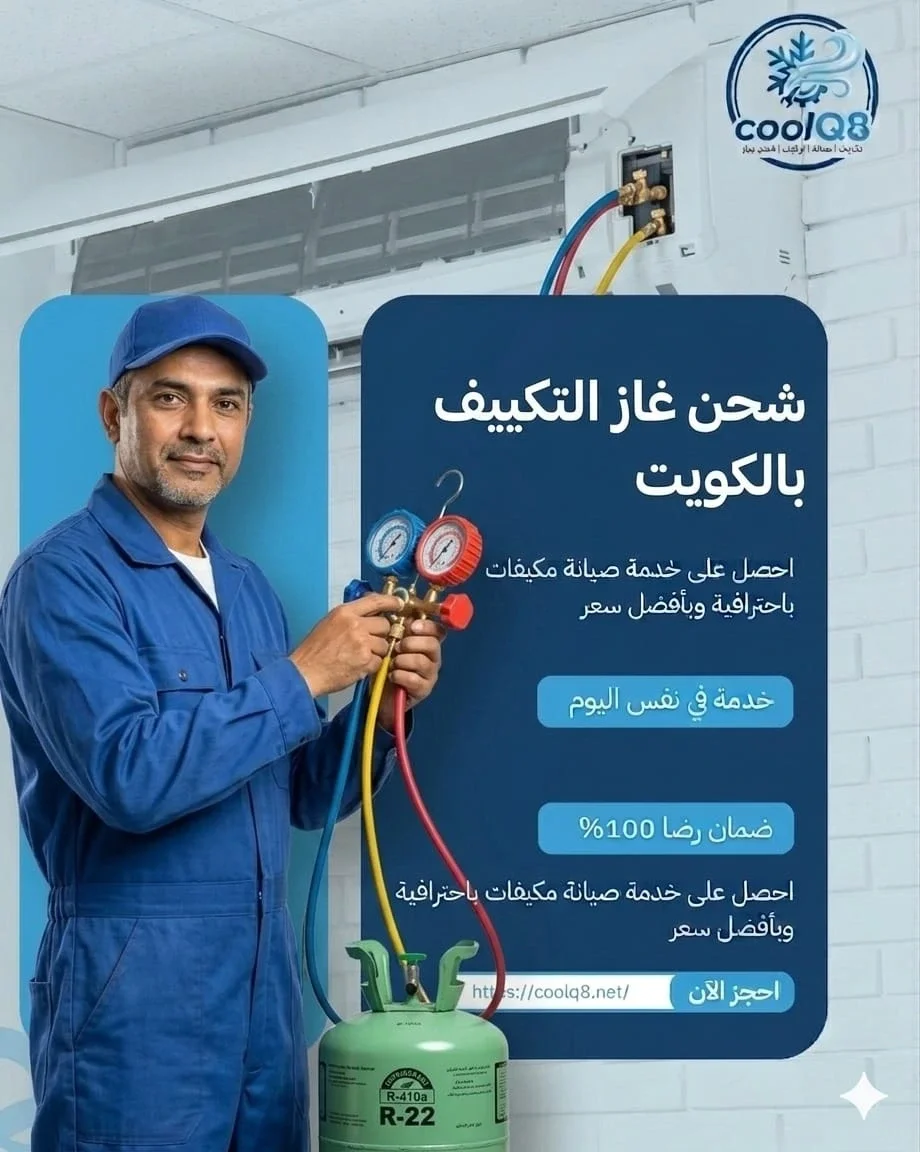
Split AC Gas Refill Kuwait
Split Air Conditioner Gas Recharge in Kuwait is one of the most frequently requested air conditioning services during the summer season. However, many cases of poor cooling performance are not actually caused by low refrigerant. Instead, they may result from dirty evaporator coils, clogged air filters, restricted airflow, faulty fans, or refrigerant leaks within the sealed cooling circuit. For this reason, professional HVAC technicians never begin by adding refrigerant immediately. Instead, they perform a complete engineering diagnosis to identify the true cause of the problem before taking corrective action. At Cool Kuwait, every service follows a structured engineering procedure that starts with system inspection, pressure measurement, refrigerant leak detection, permanent leak repair when necessary, and finally accurate refrigerant charging according to the manufacturer's specifications. This systematic approach restores cooling performance, protects the compressor, improves energy efficiency, and ensures reliable long-term operation.
Split Air Conditioner Gas Recharge in Kuwait
Professional Split Air Conditioner Gas Recharge in Kuwait begins with understanding one important engineering principle that many homeowners are unaware of: the refrigeration circuit inside a split air conditioner is a completely sealed system that does not consume refrigerant during normal operation. Therefore, whenever refrigerant levels decrease, it usually indicates the presence of a leak somewhere within the refrigeration circuit. For this reason, experienced HVAC technicians never assume that weak cooling automatically means the unit simply needs additional refrigerant. Instead, they begin by measuring operating pressures, refrigerant temperatures, compressor performance, and indoor airflow to determine whether the cooling problem is genuinely caused by low refrigerant or by another mechanical or maintenance issue. Practical field experience has shown that many air conditioners reported as requiring refrigerant charging were actually suffering from dirty evaporator coils, clogged air filters, restricted airflow, or faulty fan operation rather than refrigerant loss. Accurate diagnosis therefore represents the first step toward a permanent repair instead of a temporary solution.
Professional Split Air Conditioner Gas Recharge in Kuwait involves much more than connecting a refrigerant cylinder to the air conditioning system. Before adding any refrigerant, HVAC technicians perform detailed refrigeration pressure measurements, temperature analysis, and complete inspection of the refrigeration circuit. If refrigerant loss is confirmed, electronic leak detectors and nitrogen pressure testing are used to identify the exact location of the leak before any refrigerant is added. Recharging an air conditioner without repairing the refrigerant leak simply allows the problem to return after a short period regardless of refrigerant quality. Technicians also verify the correct refrigerant type specified by the manufacturer and never mix different refrigerants inside the same refrigeration circuit, ensuring safe compressor operation and maximum cooling efficiency.
Once Split Air Conditioner Gas Recharge in Kuwait has been completed, technicians operate the air conditioning system while measuring refrigeration pressures, discharge temperatures, compressor electrical current, and supply air temperature to verify that the system is operating within manufacturer specifications. The refrigeration circuit is inspected once again to confirm the absence of leaks or abnormal operating conditions before customers receive a technical report explaining the cause of refrigerant loss, repairs completed, and recommendations for maintaining long-term cooling performance while preventing future refrigerant leaks.
Split AC Gas Charging
Professional Split AC Gas Charging is a highly precise engineering procedure that depends upon accurate measurements rather than estimation or personal experience alone. Both excessive refrigerant and insufficient refrigerant reduce cooling efficiency even if the air conditioner initially appears to cool normally. For this reason, technicians begin by measuring operating pressures, indoor and outdoor temperatures, refrigerant line temperatures, compressor performance, and superheat or subcooling values depending upon the system design. These engineering measurements allow technicians to calculate the exact refrigerant quantity required instead of relying on guesswork, ensuring the refrigeration system operates within its designed performance range.
During Split AC Gas Charging, refrigerant is introduced using calibrated electronic weighing scales whenever manufacturer specifications require charging by weight. In other situations, refrigeration pressures and thermodynamic operating values are carefully monitored throughout the charging procedure. Outdoor ambient temperature, refrigerant type, compressor condition, cooling coil cleanliness, and overall refrigeration performance are all evaluated because each of these variables directly influences operating pressures and refrigerant behavior. Professional HVAC technicians never continue adding refrigerant simply because cooling appears to improve temporarily, since excessive refrigerant can increase discharge pressure, overload the compressor, reduce system efficiency, and shorten equipment lifespan.
Following Split AC Gas Charging, the air conditioner operates under normal working conditions while technicians verify stable refrigeration pressures, consistent cooling temperatures, proper thermostat response, normal compressor current, and balanced airflow. Ice formation, extended compressor running times, inadequate cooling, and other symptoms that existed before charging are carefully monitored to ensure they have been completely eliminated. Only after all engineering measurements confirm correct operation is the charging procedure considered complete.
Split AC Refrigerant Recharge
Professional Split AC Refrigerant Recharge represents the final stage of the repair process rather than the first. Refrigerant should only be added after technicians have confirmed that the refrigeration circuit is completely sealed and free from leaks. For this reason, experienced HVAC professionals first repair any detected refrigerant leaks before performing nitrogen pressure testing and deep vacuum evacuation to remove air and moisture from the refrigeration system. Vacuum evacuation is one of the most important engineering procedures because moisture trapped inside the refrigeration circuit can produce acid formation, internal corrosion, reduced cooling performance, and premature compressor failure even after refrigerant has been successfully recharged.
During Split AC Refrigerant Recharge, technicians always use the exact refrigerant specified by the equipment manufacturer and never substitute alternative refrigerants regardless of apparent similarities. Every refrigerant possesses unique thermodynamic characteristics and operating pressures for which the compressor, expansion device, and refrigeration circuit were specifically designed. Dedicated charging hoses, refrigerant gauges, and professional charging equipment are used to prevent refrigerant contamination while eliminating the possibility of introducing air into the refrigeration circuit. The exact refrigerant quantity is measured according to manufacturer specifications to restore original cooling performance and maintain system reliability.
After completing Split AC Refrigerant Recharge, technicians perform comprehensive operational testing including refrigeration pressure measurements, cooling temperature verification, electrical current monitoring, airflow analysis, and compressor performance evaluation. Customers receive a detailed explanation describing the original cause of refrigerant loss together with practical maintenance recommendations that help detect future refrigeration problems early, protect compressor reliability, reduce maintenance costs, and maximize the operational lifespan of the split air conditioning system.
Split AC Gas Recharge Cost
The Split AC Gas Recharge Cost varies from one air conditioner to another because the service involves far more than simply adding refrigerant. The final cost depends on several technical factors that can only be determined after a complete engineering inspection of the system. These factors include the type of refrigerant used, whether the unit operates with R410A or R32, the actual amount of refrigerant lost, the condition of the compressor, the presence of refrigerant leaks that require repair, the total length of the refrigerant piping, and whether additional maintenance procedures are required before the system can be safely recharged. For this reason, Cool Kuwait never provides arbitrary fixed prices without first inspecting the equipment. Every system is professionally evaluated to ensure customers receive an accurate quotation based solely on the actual technical requirements of their air conditioner.
The Split AC Gas Recharge Cost also includes several engineering procedures beyond refrigerant charging itself. Professional service begins with complete refrigeration system diagnostics, operating pressure measurements, electronic refrigerant leak detection, permanent repair of any detected leaks, nitrogen pressure testing, deep vacuum evacuation, and finally precise refrigerant charging according to the manufacturer's specifications. After charging is complete, technicians perform comprehensive operational testing to verify that cooling performance has been fully restored and that no hidden defects remain within the refrigeration circuit. Customers therefore receive a complete engineering repair rather than a temporary refrigerant refill that fails to solve the original problem.
Once the Split AC Gas Recharge Cost has been determined, technicians explain every stage of the proposed work in detail. Customers receive a clear description of the cause of refrigerant loss, the repairs required before charging, the refrigerant type that will be used, and the testing procedures that will follow. This transparent engineering approach allows customers to understand exactly what they are paying for while ensuring long-term cooling performance instead of repeated refrigerant refills.
R410A Refrigerant Recharge
Professional R410A Refrigerant Recharge requires specialized technical knowledge because R410A operates at significantly higher working pressures than older refrigerants. The charging procedure differs from many traditional refrigeration systems and must always follow manufacturer engineering specifications. Before any refrigerant is added, technicians verify that the air conditioner was originally designed to operate with R410A before measuring refrigeration pressures, operating temperatures, compressor performance, and overall system efficiency. If refrigerant loss is confirmed, the complete refrigeration circuit is inspected using electronic leak detectors and nitrogen pressure testing so that every leak is permanently repaired before charging begins. Simply adding refrigerant without eliminating the source of leakage will only result in recurring refrigerant loss regardless of refrigerant quality.
During R410A Refrigerant Recharge, refrigerant is introduced into the refrigeration system in liquid form according to manufacturer recommendations while the exact refrigerant quantity is measured using calibrated electronic weighing equipment. Before charging begins, technicians perform complete vacuum evacuation to remove all moisture and air from the refrigeration circuit because contamination inside high-pressure R410A systems may reduce cooling efficiency, increase compressor operating temperatures, and shorten equipment lifespan. Professional charging equipment specifically rated for the operating pressures of R410A is always used to ensure maximum safety, measurement accuracy, and refrigeration performance throughout the charging procedure.
After completing R410A Refrigerant Recharge, technicians carefully monitor refrigeration pressures, operating temperatures, compressor electrical current, superheat or subcooling values where applicable, and overall cooling capacity. The refrigeration system is observed under normal operating conditions to verify stable compressor performance and full restoration of cooling efficiency. Every refrigerant connection is inspected once more to confirm complete leak elimination before the system is returned to normal service.
R32 Refrigerant Recharge
Professional R32 Refrigerant Recharge requires strict adherence to manufacturer procedures because R32 refrigerant offers high cooling efficiency and lower environmental impact while requiring specialized handling procedures and appropriate service equipment. Every charging procedure begins by confirming that the air conditioning system was specifically designed to operate with R32 refrigerant. Technicians then measure refrigeration pressures, operating temperatures, compressor performance, and complete refrigeration system operation to verify that poor cooling is genuinely caused by refrigerant loss rather than electrical faults, airflow restrictions, dirty coils, or other mechanical problems.
During R32 Refrigerant Recharge, every engineering procedure follows internationally recognized HVAC servicing standards. Any refrigerant leak discovered during inspection is permanently repaired before the refrigeration circuit undergoes complete vacuum evacuation using professional vacuum pumps that remove air and moisture from the sealed system. Refrigerant charging is then performed using calibrated electronic weighing scales to ensure that the exact manufacturer-specified refrigerant quantity is introduced into the system. Dedicated charging hoses, pressure gauges, and servicing equipment designed specifically for R32 refrigerant are always used to maintain charging accuracy while complying with all recommended safety procedures throughout the service process.
After completing R32 Refrigerant Recharge, technicians perform comprehensive operational testing including refrigeration pressure analysis, cooling temperature measurements, compressor current monitoring, electrical performance evaluation, airflow verification, and complete refrigeration system stability testing. Customers also receive practical guidance explaining the warning signs that may indicate future refrigerant leakage and the importance of arranging professional inspection immediately if cooling performance changes. Early diagnosis helps protect the compressor, maintain maximum energy efficiency, reduce future repair costs, and significantly extend the operational life of the split air conditioning system.
Low Split AC Refrigerant
Low Split AC Refrigerant is one of the most common reasons behind reduced cooling performance, yet it is also one of the most misunderstood HVAC problems. Many homeowners assume that any decrease in cooling automatically means the air conditioner simply needs additional refrigerant. In reality, a split air conditioner operates with a completely sealed refrigeration circuit that does not consume refrigerant during normal operation. Therefore, whenever refrigerant levels drop, the system is almost always experiencing a leak somewhere within the refrigeration circuit. For this reason, professional HVAC technicians begin by measuring refrigeration pressures, compressor performance, suction and discharge temperatures, and airflow before considering refrigerant charging. Accurate diagnosis prevents unnecessary refrigerant charging while ensuring the true cause of the problem is identified and permanently repaired.
The symptoms of Low Split AC Refrigerant usually develop gradually rather than appearing suddenly. Homeowners may notice that the air conditioner requires much longer to cool the room, that supply air is no longer as cold as before, or that ice begins forming on the refrigerant pipes or evaporator coil. The compressor may operate continuously without reaching the desired indoor temperature, while electricity consumption increases because the system works harder to compensate for reduced refrigeration efficiency. Ignoring these warning signs can place excessive stress on the compressor because insufficient refrigerant reduces both cooling capacity and compressor cooling, eventually leading to overheating, increased mechanical wear, and expensive compressor failure.
Once Low Split AC Refrigerant has been confirmed, technicians use electronic refrigerant leak detectors or nitrogen pressure testing to identify the exact location of the leak before performing permanent repairs. After the refrigeration circuit has been completely sealed, the system undergoes pressure testing, vacuum evacuation, and precise refrigerant charging according to manufacturer specifications. This engineering approach restores the air conditioner to its original operating condition while protecting the compressor, improving cooling efficiency, reducing electricity consumption, and preventing repeated refrigerant loss.
Split AC Gas Recharging
Professional Split AC Gas Recharging should only be performed after technicians have confirmed that the refrigeration circuit is completely sealed and free from refrigerant leaks. Recharging refrigerant without repairing the source of refrigerant loss simply allows the newly added refrigerant to escape again within a short period of time. For this reason, experienced HVAC engineers begin by repairing every detected leak before performing nitrogen pressure testing to verify complete sealing of the refrigeration system. Once the refrigeration circuit has passed the pressure test, technicians perform deep vacuum evacuation to remove all moisture and air before introducing new refrigerant into the system.
During Split AC Gas Recharging, the exact refrigerant quantity specified by the equipment manufacturer is introduced using calibrated electronic weighing equipment and professional charging instruments. Refrigeration pressures, ambient temperature, compressor performance, refrigerant temperatures, and thermodynamic operating values are continuously monitored throughout the charging procedure to ensure the refrigeration system operates exactly within its original design specifications. Mixing refrigerant types or estimating refrigerant quantity by guesswork is never acceptable because even small charging errors can reduce cooling performance, overload the compressor, and shorten equipment lifespan.
Following Split AC Gas Recharging, technicians allow the air conditioner to operate under normal conditions while carefully observing refrigeration pressures, cooling temperatures, compressor electrical current, thermostat response, and overall system stability. The symptoms that originally affected the air conditioner—such as poor cooling, continuous compressor operation, or ice formation—are monitored to verify complete elimination of the problem. Customers also receive practical maintenance recommendations explaining how early inspection can prevent future refrigerant loss and reduce long-term repair costs.
Split AC Gas Recharge Technician
The quality of refrigerant charging depends largely upon the experience and technical knowledge of the Split AC Gas Recharge Technician, because servicing refrigeration systems requires engineering expertise rather than simply adding refrigerant. A qualified HVAC technician understands how to distinguish between refrigerant-related problems and electrical faults, airflow restrictions, compressor defects, dirty heat exchangers, sensor failures, or control system malfunctions that may produce similar symptoms. Every professional service therefore begins with detailed refrigeration diagnostics before any decision is made regarding refrigerant charging. This prevents unnecessary repairs while ensuring customers receive the correct engineering solution for the actual fault affecting their air conditioner.
A professional Split AC Gas Recharge Technician performs much more than refrigerant charging alone. Responsibilities include refrigeration pressure analysis, leak detection, nitrogen pressure testing, vacuum evacuation, refrigerant recovery where necessary, refrigerant charging according to manufacturer specifications, compressor performance evaluation, electrical testing, airflow verification, and final operational analysis. Professional technicians also use calibrated gauges, electronic weighing scales, leak detection equipment, vacuum pumps, and pressure testing instruments that ensure every engineering measurement remains accurate throughout the repair process. Reliance upon estimation or outdated servicing methods can significantly reduce refrigeration efficiency while increasing the risk of future compressor damage.
After completing the service, the Split AC Gas Recharge Technician explains the condition of the refrigeration system, identifies the original cause of refrigerant loss, describes every repair performed, and provides maintenance recommendations that help prevent future refrigeration problems. This transparent engineering approach allows customers to understand the technical condition of their equipment while building confidence that repairs have addressed the underlying problem rather than merely treating visible symptoms.
Split AC Gas Recharge at Home
Professional Split AC Gas Recharge at Home provides homeowners with a convenient solution that eliminates the need to remove or transport the air conditioner to a service workshop. Experienced HVAC technicians arrive fully equipped with professional refrigeration gauges, electronic leak detectors, vacuum pumps, nitrogen cylinders, electronic weighing scales, and the correct refrigerant required for the specific air conditioning system. The entire engineering procedure—from diagnosis through final commissioning—is performed directly at the customer's location while maintaining the same professional standards applied in specialized HVAC service facilities.
Professional Split AC Gas Recharge at Home does not represent a simplified version of workshop repairs. Every engineering procedure normally carried out inside a professional service center—including refrigeration pressure measurements, electronic leak detection, nitrogen pressure testing, vacuum evacuation, precise refrigerant charging, compressor performance analysis, airflow verification, electrical testing, and operational commissioning—is completed on-site using advanced portable HVAC equipment. This allows homeowners to receive complete professional service without interrupting the installation or removing the equipment from its normal operating location.
After completing Split AC Gas Recharge at Home, technicians operate the air conditioning system for an extended period while monitoring refrigeration pressures, cooling temperatures, airflow performance, compressor operation, electrical current, and overall system stability. Customers receive practical maintenance advice concerning regular cleaning, preventive inspections, and the importance of requesting professional diagnosis immediately whenever cooling performance changes. This complete on-site engineering service restores reliable cooling performance while minimizing inconvenience and ensuring long-term HVAC reliability.
Conclusion
Split Air Conditioner Gas Recharge in Kuwait is not simply a matter of adding refrigerant to improve cooling. It is a complete engineering procedure that begins with accurate diagnosis and ends with comprehensive performance verification. Whether you require Split Air Conditioner Gas Recharge in Kuwait, Split AC Gas Charging, Split AC Refrigerant Recharge, information regarding the Split AC Gas Recharge Cost, R410A Refrigerant Recharge, R32 Refrigerant Recharge, diagnosis of Low Split AC Refrigerant, Split AC Gas Recharging, assistance from a professional Split AC Gas Recharge Technician, or convenient Split AC Gas Recharge at Home, the most important step is always identifying and permanently repairing the cause of refrigerant loss before charging the system. At Cool Kuwait, every service follows professional HVAC engineering standards using advanced diagnostic equipment, accurate testing procedures, manufacturer-approved refrigerants, and comprehensive operational verification. This systematic approach restores maximum cooling efficiency, protects the compressor, reduces electricity consumption, extends equipment lifespan, and provides customers with reliable long-term cooling performance.
Frequently Asked Questions
When does a split air conditioner require refrigerant charging?
A Split Air Conditioner Gas Recharge in Kuwait is only required after confirming that refrigerant has been lost because of a leak within the refrigeration circuit. Refrigerant is not consumed during normal operation.
Is Low Split AC Refrigerant considered normal?
No. Low Split AC Refrigerant almost always indicates a refrigerant leak that must be professionally located and permanently repaired before additional refrigerant is added.
What is the difference between Split AC Gas Charging and Split AC Refrigerant Recharge?
There is essentially no technical difference. Both Split AC Gas Charging and Split AC Refrigerant Recharge describe restoring the correct refrigerant quantity after repairing the cause of refrigerant loss.
How is the Split AC Gas Recharge Cost determined?
The Split AC Gas Recharge Cost depends on the refrigerant type, amount of refrigerant required, condition of the air conditioner, presence of refrigerant leaks, and the engineering procedures necessary before charging can safely be completed.
Can R410A be replaced with R32?
No. R410A Refrigerant Recharge and R32 Refrigerant Recharge are not interchangeable. Every air conditioner must always be charged with the refrigerant specified by its manufacturer.
Is vacuum evacuation necessary before refrigerant charging?
Yes. Vacuum evacuation removes moisture and air from the refrigeration circuit, protecting compressor reliability while ensuring maximum cooling efficiency.
What happens if excessive refrigerant is added?
Overcharging increases operating pressures, places excessive stress on the compressor, reduces cooling efficiency, and may significantly shorten the lifespan of the refrigeration system.
Can a Split AC Gas Recharge Technician detect refrigerant leaks?
Yes. A professional Split AC Gas Recharge Technician uses electronic refrigerant leak detectors, nitrogen pressure testing, and advanced diagnostic procedures to accurately locate refrigerant leaks before repairs are performed.
Can Split AC Gas Recharge at Home be performed professionally?
Yes. Split AC Gas Recharge at Home can be completed using professional portable HVAC equipment that allows technicians to perform diagnosis, leak detection, repairs, vacuum evacuation, refrigerant charging, and operational testing directly at the customer's location.
How long does professional refrigerant charging usually take?
Most professional inspections, leak repairs, vacuum evacuation, and refrigerant charging procedures require approximately one to two hours, although larger repairs involving significant refrigerant leaks or component replacement may require additional time to ensure proper engineering standards are maintained.