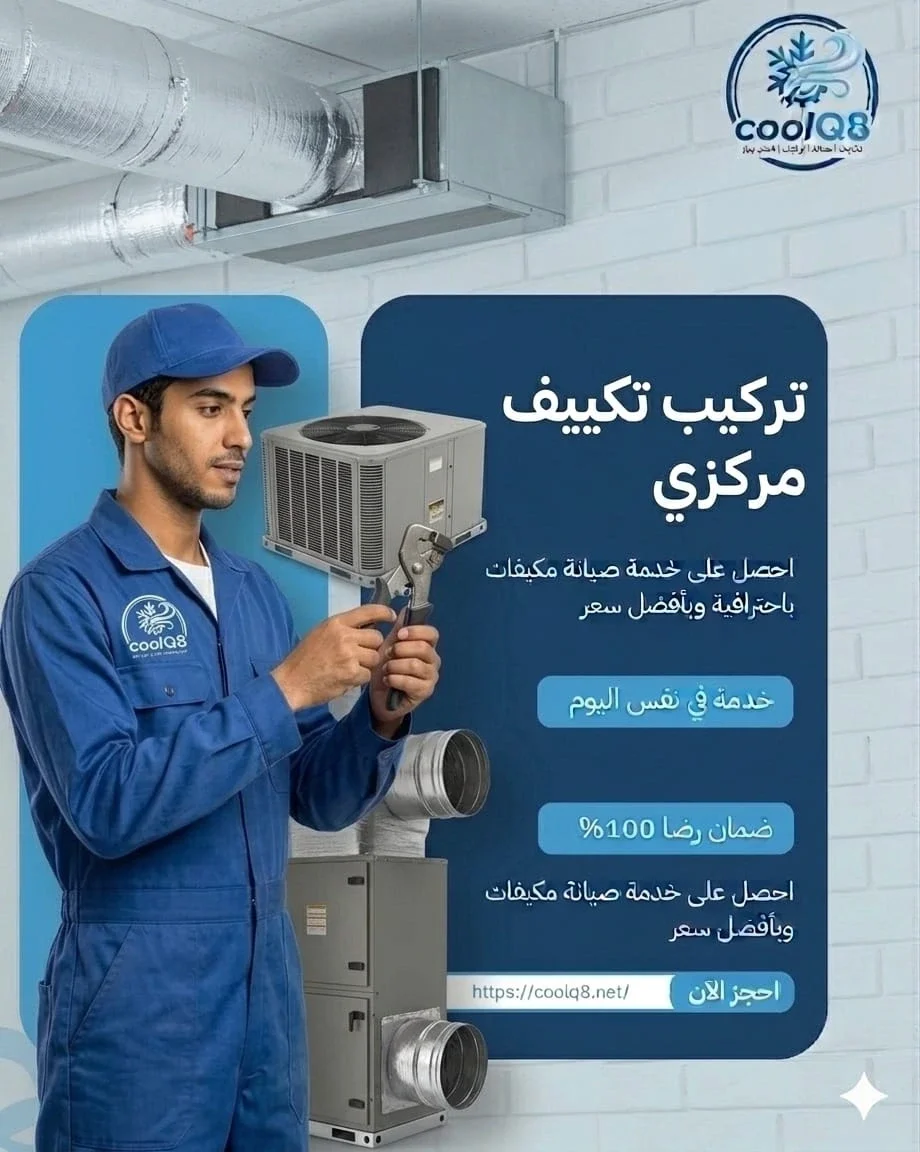
Central AC Installation Kuwait
Central Air Conditioning Installation in Kuwait is one of the most important decisions affecting indoor comfort, energy consumption, operating costs, and long-term HVAC performance. The quality of installation is just as important as the quality of the air conditioning equipment itself. Many problems that appear after months or even years of operation are not caused by defective equipment but by poor system design, inaccurate load calculations, improper duct installation, or selecting equipment with incorrect cooling capacities. At Cool Kuwait, every project follows a complete engineering methodology that begins with analyzing the building's cooling requirements, calculating actual thermal loads, designing the HVAC system, selecting suitable equipment, and executing every installation phase according to internationally recognized engineering standards. This systematic approach ensures maximum cooling efficiency, minimum energy consumption, simplified future maintenance, and reliable long-term operation.
Central Air Conditioning Installation in Kuwait
Professional Central Air Conditioning Installation in Kuwait does not begin when equipment arrives at the construction site. Instead, it starts much earlier with a comprehensive engineering study that evaluates the building layout, number of floors, façade orientation, insulation quality, window distribution, room dimensions, ceiling heights, occupancy patterns, and the intended use of every individual space. This engineering assessment allows HVAC specialists to calculate the actual thermal loads instead of relying on rough estimates that may result in oversized or undersized equipment. Practical experience from numerous installation projects has demonstrated that poor load calculations frequently cause uneven room temperatures, excessive electricity consumption, uncomfortable indoor conditions, and unnecessary mechanical stress on HVAC equipment. Proper engineering analysis from the beginning helps eliminate these problems while providing customers with a highly efficient system designed specifically for their building.
Professional Central Air Conditioning Installation in Kuwait includes every technical phase required to deliver a fully operational HVAC system. These phases include determining the ideal locations for indoor and outdoor equipment, installing refrigerant piping or chilled water piping depending on the selected system, positioning air handling units, constructing and insulating ductwork, installing air outlets and thermostats, completing condensate drainage systems, and integrating electrical control systems. Throughout every stage of installation, technicians carefully follow engineering specifications governing pipe routing, duct dimensions, suspension systems, insulation thickness, airflow direction, equipment spacing, and installation tolerances. Even relatively small installation errors can significantly affect cooling performance, increase operating noise, reduce equipment efficiency, or shorten the operational lifespan of expensive HVAC components.
After completing Central Air Conditioning Installation in Kuwait, the project does not immediately proceed to customer handover. Instead, a comprehensive commissioning process begins during which technicians carefully measure refrigeration pressures, airflow velocities, operating temperatures, electrical current consumption, thermostat response, and overall cooling performance throughout every conditioned area. Airflow balancing adjustments are performed to ensure uniform cooling distribution across all rooms while operating data is compared with original engineering design calculations. Customers receive a complete engineering commissioning report confirming that the HVAC system meets all approved performance specifications before final acceptance. This systematic engineering process provides long-term confidence that the installation has been completed according to professional international HVAC standards.
Central Air Conditioning System Pre-Installation
Professional Central Air Conditioning System Pre-Installation forms the true foundation of every successful HVAC project because mistakes made during this phase become extremely difficult and expensive to correct after interior finishing work has been completed. For this reason, pre-installation activities are normally performed during the earliest stages of building construction before ceilings and walls are permanently closed. HVAC engineers first review architectural, structural, and mechanical drawings before preparing detailed installation layouts showing duct routes, air handling unit locations, mechanical room arrangements, electrical pathways, drainage systems, and maintenance access points. Careful planning during this stage ensures that every HVAC component can be installed efficiently while remaining fully accessible for future servicing without damaging completed architectural finishes.
Professional Central Air Conditioning System Pre-Installation involves considerably more than simply preparing spaces for equipment installation. Engineers calculate thermal loads, determine duct dimensions, select air outlet locations, evaluate ceiling heights, coordinate HVAC systems with plumbing, electrical, and fire protection services, and identify the most efficient routing for refrigerant piping or chilled water systems. Every engineering decision is made to maximize cooling efficiency while preserving valuable interior space and preventing future conflicts between different building services. Proper coordination during this stage greatly reduces construction delays, minimizes unnecessary modifications, and ensures smoother installation throughout the remainder of the project.
Once Central Air Conditioning System Pre-Installation has been completed, all installed infrastructure undergoes careful inspection before construction continues. Suspension systems, insulation materials, duct routing, refrigerant piping, chilled water piping where applicable, electrical conduits, drainage lines, and service access locations are thoroughly verified against approved engineering drawings. Early identification of any installation discrepancies allows corrections to be completed before ceilings are closed or finishing work begins, significantly improving construction quality while reducing future maintenance difficulties and project costs.
Central Air Conditioning Installation for Villas
Professional Central Air Conditioning Installation for Villas requires a completely different engineering philosophy from commercial HVAC installations because residential comfort depends not only on cooling capacity but also on quiet operation, balanced airflow, consistent room temperatures, and seamless integration with luxury interior finishes. Every villa installation therefore begins with a comprehensive engineering analysis of the complete residence, including room dimensions, ceiling heights, insulation quality, window orientation, occupancy patterns, solar heat gain, and daily living habits. Thermal loads are calculated independently for every room to ensure that each area receives precisely the amount of conditioned air required for maximum comfort rather than relying upon generalized airflow distribution that frequently creates temperature imbalances throughout the home.
During Central Air Conditioning Installation for Villas, air handling units are strategically positioned to provide convenient future maintenance while remaining hidden from occupied living spaces. Ductwork is carefully designed using high-quality thermal insulation to minimize cooling losses, prevent condensation, and reduce operating noise. Air outlets are precisely positioned to distribute conditioned air evenly throughout each room without directing airflow toward beds, seating areas, or frequently occupied locations. Air velocities inside the duct system are calculated according to engineering standards to minimize noise while maintaining excellent airflow distribution throughout every floor of the villa. These design principles significantly improve indoor comfort while reducing long-term operating costs.
Following Central Air Conditioning Installation for Villas, technicians perform comprehensive commissioning procedures throughout every room and floor of the residence. Indoor temperatures, airflow velocities, sound levels, thermostat operation, electrical performance, and cooling efficiency are carefully measured before airflow balancing adjustments are completed wherever necessary. This final engineering verification ensures that every area of the villa receives uniform cooling performance while maintaining maximum equipment efficiency, reduced electricity consumption, quiet operation, and long-term system reliability.
Central Air Conditioning Installation for Buildings
Professional Central Air Conditioning Installation for Buildings requires a significantly higher level of engineering planning because every building has unique operational requirements, occupancy patterns, cooling loads, and ventilation demands. Office buildings, shopping centers, schools, hospitals, hotels, industrial facilities, and mixed-use developments all require customized HVAC solutions designed specifically for their intended function. Every project therefore begins with a complete engineering assessment that includes reviewing architectural drawings, calculating thermal loads for every floor, evaluating occupancy density, analyzing equipment-generated heat, assessing solar exposure, and determining fresh air ventilation requirements. These engineering calculations ensure that every area of the building receives the correct cooling capacity while maintaining energy efficiency and occupant comfort throughout continuous daily operation.
Professional Central Air Conditioning Installation for Buildings extends far beyond equipment placement. The complete installation process includes installing chillers or DX systems where applicable, positioning air handling units, constructing insulated duct networks, connecting chilled water or refrigerant piping, installing electrical power and control systems, integrating building automation systems, and completing condensate drainage networks. Every mechanical component is installed according to engineering calculations governing structural loading, vibration isolation, airflow balance, maintenance accessibility, and long-term operational reliability. Careful coordination with electrical contractors, plumbing systems, fire protection installations, and architectural finishes ensures that every HVAC component functions efficiently without interfering with other building services.
Following Central Air Conditioning Installation for Buildings, technicians perform comprehensive commissioning under full operating conditions. Airflow distribution, cooling temperatures, refrigeration pressures, chilled water temperatures where applicable, electrical demand, ventilation performance, and control system response are measured throughout every floor and occupied space. Air balancing adjustments are completed wherever necessary to achieve uniform environmental conditions across the building. Detailed commissioning documentation is then prepared, confirming that the installation satisfies all engineering specifications before final project handover.
Central Air Conditioning Duct Installation
Professional Central Air Conditioning Duct Installation is one of the most critical phases of HVAC construction because the duct network serves as the primary pathway through which conditioned air is delivered throughout the building. Even the highest quality cooling equipment cannot perform efficiently if ductwork is improperly designed or installed. Every duct installation project therefore begins with detailed engineering calculations that determine duct dimensions, airflow velocities, static pressure requirements, branch locations, diffuser positions, and return air pathways based upon the thermal load calculated for every individual space. Proper engineering design minimizes pressure losses while ensuring balanced airflow throughout the entire building.
During Central Air Conditioning Duct Installation, galvanized steel duct sections are professionally fabricated according to approved engineering drawings before being installed using heavy-duty suspension systems capable of supporting the full operating weight of the duct network. Every duct joint is carefully sealed to prevent conditioned air leakage while premium thermal insulation is installed to minimize cooling losses and eliminate condensation. Vibration isolators, flexible connectors, acoustic insulation, fire dampers, balancing dampers, and access panels are incorporated wherever required to improve operational performance, simplify future maintenance, and reduce operating noise. Installation is continuously coordinated with electrical, plumbing, and fire protection contractors to eliminate conflicts within ceiling spaces and service areas.
Upon completion of Central Air Conditioning Duct Installation, technicians conduct comprehensive airflow testing throughout the entire duct system. Air leakage tests, airflow measurements, static pressure readings, diffuser balancing, and ventilation performance evaluations are performed to verify that the installed ductwork delivers the airflow quantities specified in the engineering design. Any necessary balancing adjustments are completed before the HVAC system proceeds to final commissioning, ensuring maximum cooling efficiency, excellent indoor comfort, and long-term operational reliability.
Central Air Conditioning System Design
Professional Central Air Conditioning System Design represents the engineering foundation upon which every successful HVAC installation is built. Every design project begins with a detailed thermal load analysis performed using specialized HVAC engineering software that evaluates building dimensions, construction materials, insulation quality, window orientation, glazing performance, occupancy levels, lighting systems, electrical equipment, fresh air requirements, and Kuwait's demanding climatic conditions. These calculations allow engineers to determine the exact cooling capacity required for every individual room and operating zone, eliminating the inefficiencies associated with oversized or undersized HVAC systems while maximizing long-term energy efficiency.
Professional Central Air Conditioning System Design includes much more than selecting air conditioning equipment. Engineers determine the most appropriate HVAC technology for each project, whether utilizing chilled water systems, DX systems, packaged units, VRF technology where appropriate, or other central cooling solutions. Air handling units, duct layouts, diffuser locations, return air systems, ventilation equipment, filtration systems, control strategies, building automation interfaces, refrigeration piping, condensate drainage, and future maintenance access are all incorporated into a fully integrated engineering design. Airflow velocities are carefully calculated to minimize operating noise while maintaining balanced air distribution throughout every occupied space. Every engineering decision is made to maximize cooling performance, simplify maintenance, reduce operating costs, and improve long-term equipment reliability.
After completing the Central Air Conditioning System Design, every engineering drawing, equipment schedule, airflow calculation, duct layout, and installation detail undergoes comprehensive technical review before construction begins. HVAC engineers coordinate closely with architects, structural engineers, electrical consultants, plumbing designers, and fire protection specialists to ensure complete integration between all building systems. This multidisciplinary engineering coordination minimizes construction delays, prevents installation conflicts, improves project quality, and provides contractors with accurate documentation that supports efficient installation while maintaining full compliance with international HVAC engineering standards.
Central Air Conditioning Installation Cost
The Central Air Conditioning Installation Cost varies from one project to another because the total investment is influenced by far more than the size of the building alone. Professional HVAC engineers evaluate numerous technical factors before preparing an accurate quotation, including the selected cooling system type, required cooling capacity, number of air handling units, total ductwork length, insulation specifications, quantity of supply and return air outlets, architectural complexity, ceiling configurations, electrical infrastructure, and the overall readiness of the construction site. Rather than providing generalized price estimates, Cool Kuwait begins every project with a comprehensive engineering site survey followed by detailed thermal load calculations and system design. This approach allows customers to receive an accurate quotation based upon actual project requirements instead of paying for unnecessary equipment or discovering costly changes after installation has already begun.
The Central Air Conditioning Installation Cost includes considerably more than the purchase price of HVAC equipment. A complete installation budget also covers engineering design, thermal load analysis, mechanical drawings, duct fabrication, refrigerant piping or chilled water piping, electrical power distribution, control wiring, condensate drainage systems, thermal insulation, structural supports, commissioning procedures, airflow balancing, performance testing, and final engineering documentation. Material quality also plays a significant role in determining overall project value. High-quality galvanized ductwork, premium thermal insulation, original control components, certified electrical materials, and manufacturer-approved accessories increase initial investment but substantially improve system efficiency, reduce long-term maintenance costs, and extend equipment lifespan. Investing in superior installation quality generally provides far greater long-term value than selecting the lowest initial quotation without considering engineering standards.
After preparing the Central Air Conditioning Installation Cost, every quotation is carefully reviewed with the customer in complete detail. Equipment specifications, installation procedures, engineering calculations, warranty coverage, project schedules, material selections, and future maintenance recommendations are clearly explained before work begins. This transparent engineering approach allows customers to make informed decisions based upon long-term system performance rather than simply comparing installation prices.
Central Air Conditioning Unit Installation
Professional Central Air Conditioning Unit Installation begins only after all pre-installation work has been completed and the construction site is fully prepared to receive HVAC equipment. Air handling units, rooftop equipment, condensing units, chillers where applicable, and associated mechanical components are positioned according to approved engineering drawings to maximize operating efficiency while maintaining convenient future service access. Heavy-duty structural supports, vibration isolation systems, and engineered mounting assemblies are installed to reduce vibration transmission and ensure long-term mechanical stability throughout continuous operation. Equipment locations are carefully selected to provide adequate ventilation, safe maintenance access, and sufficient operating clearances while preserving the architectural appearance of the building.
Professional Central Air Conditioning Unit Installation involves considerably more than physically positioning HVAC equipment. Technicians install refrigerant piping or chilled water piping, electrical power supplies, communication cables, thermostat wiring, condensate drainage systems, and air distribution ductwork while ensuring that every connection complies with manufacturer engineering specifications. Refrigeration piping undergoes nitrogen pressure testing, leak verification, vacuum evacuation, and precise refrigerant charging where applicable before commissioning begins. Electrical control systems are programmed and calibrated while safety devices, sensors, thermostats, and automation interfaces are configured according to the designed operating sequence. Every mechanical and electrical connection is inspected multiple times throughout the installation process to ensure long-term operational reliability.
Upon completion of Central Air Conditioning Unit Installation, technicians perform comprehensive commissioning procedures that include refrigeration pressure measurements, airflow balancing, electrical current monitoring, temperature verification, thermostat calibration, vibration analysis, sound level evaluation, and complete operational testing under actual building load conditions. Any required adjustments are completed before final acceptance, ensuring that every HVAC component operates as part of one fully integrated, energy-efficient cooling system designed for dependable long-term service.
Best Central Air Conditioning Installation Company
Selecting the Best Central Air Conditioning Installation Company requires evaluating engineering capability, technical experience, installation quality, and long-term customer support rather than focusing exclusively on installation price. Central HVAC systems represent major long-term investments, making engineering accuracy and installation quality far more important than short-term cost savings. Cool Kuwait employs experienced mechanical engineers, certified HVAC specialists, skilled installation technicians, and professional commissioning engineers who manage every stage of the project from initial consultation through final system commissioning. Every installation follows internationally recognized engineering standards supported by advanced design software, professional testing instruments, and manufacturer-approved installation procedures that maximize system performance throughout its entire operating life.
A professional Best Central Air Conditioning Installation Company delivers a complete engineering solution rather than simply installing equipment. Services include thermal load calculations, HVAC system design, equipment selection, duct engineering, refrigerant piping installation, airflow balancing, electrical integration, automation programming, commissioning, performance verification, and preparation of complete technical documentation. Every project is supervised through structured quality control procedures ensuring that all mechanical, electrical, and control systems meet engineering specifications before customer handover. Preventive maintenance planning and long-term technical support are also integrated into every installation project to preserve equipment performance long after construction has been completed.
Beyond technical excellence, the Best Central Air Conditioning Installation Company provides dependable after-sales service, preventive maintenance programs, emergency technical support, genuine replacement parts, and periodic engineering inspections that help customers maintain peak HVAC performance throughout many years of operation. This commitment to engineering quality, customer support, and long-term reliability ensures maximum return on investment while minimizing operating costs, equipment failures, and future maintenance requirements.
Central Air Conditioning Project Execution
Professional Central Air Conditioning Project Execution requires precise coordination between engineering design, equipment procurement, construction scheduling, installation teams, quality control personnel, commissioning engineers, and project management specialists. Every HVAC project begins with a detailed execution plan defining installation phases, material delivery schedules, coordination meetings, inspection milestones, testing procedures, safety requirements, and final commissioning activities. Cool Kuwait prepares comprehensive project management schedules that coordinate HVAC installation with architectural construction, electrical work, plumbing systems, fire protection installations, and finishing trades to eliminate construction conflicts while maintaining project deadlines and installation quality.
Throughout Central Air Conditioning Project Execution, strict quality control procedures are applied during every stage of construction. Incoming materials are inspected before installation, duct fabrication dimensions are verified, refrigerant piping is pressure tested, electrical systems undergo insulation resistance testing, control wiring is checked, thermal insulation quality is inspected, and mechanical installations are continuously compared with approved engineering drawings. Every construction phase is documented through detailed inspection reports that provide complete project traceability while simplifying future maintenance activities. Safety procedures are rigorously enforced throughout the project to protect workers, equipment, and surrounding construction activities.
After completing Central Air Conditioning Project Execution, the entire HVAC installation undergoes comprehensive commissioning under full operating conditions. Engineers verify refrigeration performance, airflow distribution, temperature stability, electrical demand, automation system response, indoor air quality, ventilation effectiveness, and complete operational reliability throughout every conditioned area. Once every engineering requirement has been successfully verified, customers receive complete project documentation including engineering reports, commissioning certificates, operating manuals, maintenance guidelines, warranty information, and as-built drawings. This structured project delivery process ensures that every central air conditioning installation achieves maximum efficiency, dependable long-term performance, simplified future maintenance, and complete compliance with approved engineering specifications.
Conclusion
Central Air Conditioning Installation in Kuwait is far more than simply placing HVAC equipment inside a building. It is a complete engineering process that begins with accurate thermal load calculations and professional system design before progressing through pre-installation planning, duct fabrication, equipment installation, commissioning, and long-term operational verification. Whether your project requires Central Air Conditioning Installation in Kuwait, Central Air Conditioning System Pre-Installation, Central Air Conditioning Installation for Villas, Central Air Conditioning Installation for Buildings, Central Air Conditioning Duct Installation, Central Air Conditioning System Design, information about the Central Air Conditioning Installation Cost, Central Air Conditioning Unit Installation, assistance from the Best Central Air Conditioning Installation Company, or complete Central Air Conditioning Project Execution, every stage must be performed according to recognized HVAC engineering standards. At Cool Kuwait, every installation project is managed through a structured engineering methodology supported by detailed calculations, advanced design software, professional installation practices, comprehensive quality control, and complete commissioning procedures. This integrated approach delivers superior cooling performance, lower electricity consumption, balanced airflow, improved indoor comfort, simplified maintenance, and dependable long-term HVAC operation throughout Kuwait's demanding climate.
Frequently Asked Questions
When should Central Air Conditioning Installation in Kuwait begin during a construction project?
Central Air Conditioning Installation in Kuwait should ideally begin during the early stages of construction before ceilings and interior finishes are completed. Early planning allows engineers to install ductwork, refrigerant piping, drainage systems, electrical conduits, and equipment supports without requiring future demolition or expensive structural modifications. Beginning installation at the correct construction stage significantly improves project quality while reducing both installation time and future maintenance difficulties.
Why is Central Air Conditioning System Pre-Installation so important?
Professional Central Air Conditioning System Pre-Installation establishes the foundation for the entire HVAC system. During this stage, engineers determine equipment locations, duct routes, refrigerant piping paths, drainage systems, electrical connections, maintenance access points, and coordination with other building services. Proper pre-installation planning prevents costly design conflicts, improves installation efficiency, and ensures the completed HVAC system performs exactly as originally designed.
Is Central Air Conditioning Installation for Villas different from commercial buildings?
Yes. Central Air Conditioning Installation for Villas focuses primarily on residential comfort, quiet operation, balanced airflow, interior aesthetics, and personalized room-by-room cooling control. Commercial HVAC installations typically prioritize continuous operation, higher occupancy loads, larger ventilation requirements, energy management, and building automation systems. Consequently, each type of installation requires different engineering calculations and system design approaches.
What is included in Central Air Conditioning Installation for Buildings?
Professional Central Air Conditioning Installation for Buildings includes thermal load analysis, HVAC system design, installation of air handling units, chillers or DX equipment where applicable, refrigerant or chilled water piping, ductwork construction, electrical integration, automation systems, airflow balancing, commissioning, and complete operational testing before final project handover.
Why is Central Air Conditioning Duct Installation considered one of the most important installation stages?
Central Air Conditioning Duct Installation directly determines how efficiently conditioned air is distributed throughout the building. Poorly designed or improperly installed ductwork can create airflow restrictions, uneven room temperatures, excessive operating noise, increased electricity consumption, and reduced cooling efficiency. Proper engineering design ensures balanced airflow while minimizing pressure losses and maximizing overall HVAC performance.
How is a Central Air Conditioning System Design prepared?
Professional Central Air Conditioning System Design begins with detailed thermal load calculations using specialized engineering software. Engineers analyze building dimensions, insulation, occupancy, equipment loads, ventilation requirements, solar exposure, and Kuwait's environmental conditions before selecting HVAC equipment, designing duct layouts, determining airflow quantities, positioning air outlets, integrating control systems, and preparing complete construction drawings for installation.
What factors determine the Central Air Conditioning Installation Cost?
The Central Air Conditioning Installation Cost depends on numerous engineering factors including building size, cooling capacity requirements, HVAC system type, number of air handling units, ductwork complexity, insulation quality, electrical requirements, automation systems, construction conditions, equipment selection, and material specifications. Accurate pricing always requires a professional engineering site survey and detailed project evaluation rather than generalized estimates.
What does Central Air Conditioning Unit Installation include?
Professional Central Air Conditioning Unit Installation includes positioning indoor and outdoor equipment, installing structural supports, vibration isolation systems, refrigerant or chilled water piping, electrical power supplies, control wiring, condensate drainage systems, duct connections, system calibration, refrigerant charging where applicable, commissioning procedures, airflow balancing, and complete operational testing before project completion.
How do I choose the Best Central Air Conditioning Installation Company?
Selecting the Best Central Air Conditioning Installation Company should be based upon engineering expertise, certified HVAC professionals, experience with similar projects, advanced design capabilities, quality installation procedures, professional testing equipment, detailed commissioning reports, warranty coverage, preventive maintenance services, availability of genuine replacement parts, and long-term technical support rather than installation price alone.
What is included in complete Central Air Conditioning Project Execution?
Professional Central Air Conditioning Project Execution includes engineering design review, project scheduling, equipment procurement, material inspection, duct fabrication, mechanical installation, electrical integration, piping installation, quality control inspections, safety management, commissioning, airflow balancing, refrigeration testing, operational verification, preparation of as-built documentation, maintenance manuals, warranty documentation, and final customer training. This structured engineering process ensures reliable HVAC performance, maximum energy efficiency, long equipment lifespan, and complete compliance with approved engineering specifications.
