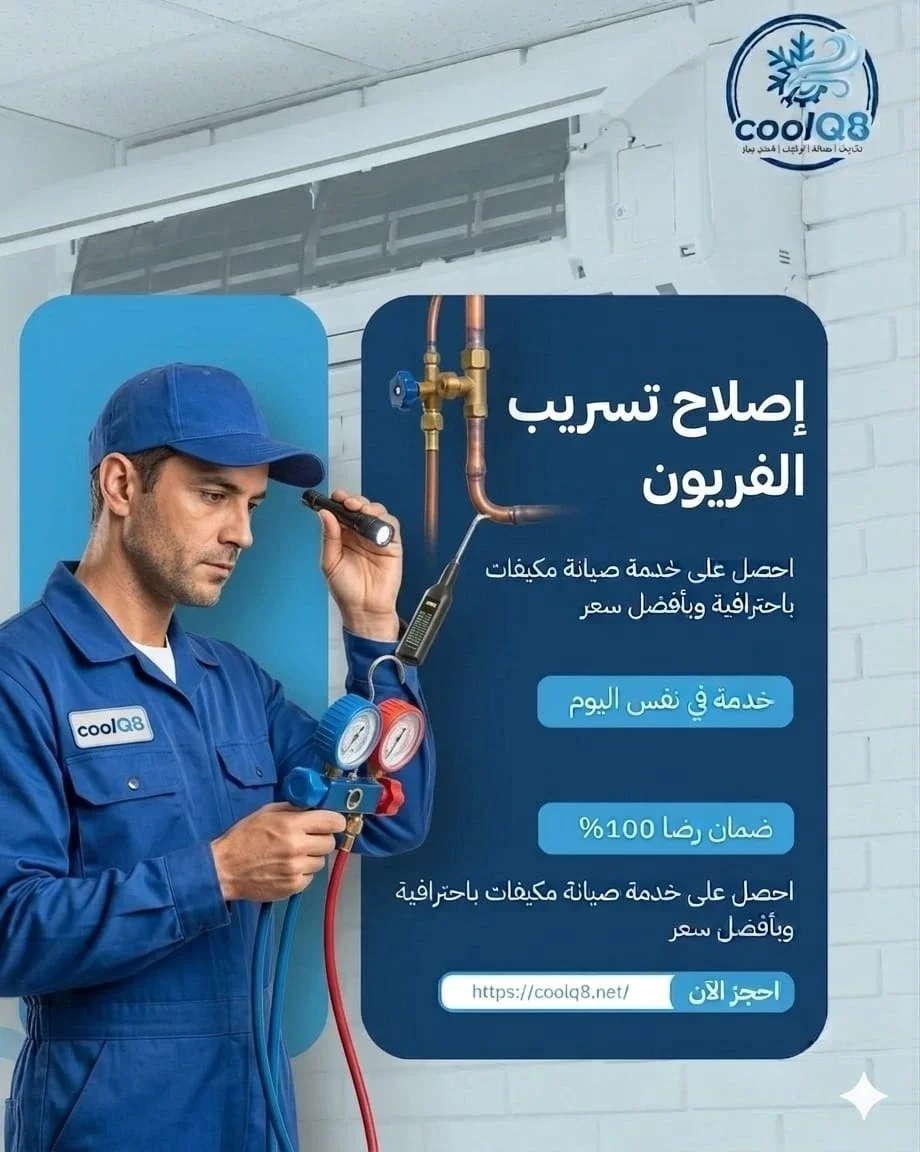
AC Freon Leak Kuwait
A Refrigerant Leak in Air Conditioners in Kuwait is one of the most common faults affecting cooling performance, yet it is also one of the most frequently misdiagnosed problems. Many homeowners believe that simply adding more refrigerant is enough to solve the issue. However, experienced HVAC professionals understand that an air conditioning refrigeration circuit is a completely sealed system. Under normal operating conditions, refrigerant is never consumed or reduced over time. Therefore, whenever refrigerant levels decrease, it indicates the presence of a leak somewhere within the refrigeration circuit that must be accurately located and permanently repaired before the system is recharged. At Cool Kuwait, every refrigerant leak is handled using a professional engineering approach that begins with comprehensive diagnostics using electronic leak detectors and pressure testing equipment, followed by permanent repair of the leaking section, complete leak verification, evacuation of the refrigeration circuit, and finally precise refrigerant charging according to manufacturer specifications. This systematic process ensures a permanent repair rather than a temporary solution that results in recurring failures.
Refrigerant Leak in Air Conditioners in Kuwait
Handling a Refrigerant Leak in Air Conditioners in Kuwait begins with understanding one important engineering principle that many customers are unaware of: refrigerant does not naturally decrease inside a properly sealed refrigeration system. Since the refrigeration circuit is completely closed, refrigerant continuously circulates without being consumed during normal operation. Therefore, whenever technicians observe low refrigerant pressure, reduced cooling capacity, frozen evaporator coils, ice formation on refrigerant pipes, or increasing electricity consumption, these symptoms usually indicate an actual refrigerant leak somewhere within the system. Practical field experience has shown that continuing to operate an air conditioner while refrigerant is leaking places excessive stress on the compressor because insufficient refrigerant reduces cooling and lubrication inside the compressor itself. As compressor operating temperatures increase, the risk of permanent compressor damage rises significantly, making immediate professional diagnosis essential before more expensive repairs become necessary.
Professional Refrigerant Leak in Air Conditioners in Kuwait diagnosis never relies on assumptions or simply adding refrigerant to restore cooling temporarily. HVAC technicians first measure refrigeration pressures, operating temperatures, compressor electrical current, and overall cooling performance before performing a detailed inspection of every refrigeration circuit component. Copper tubing, brazed joints, service valves, evaporator coils, condenser coils, compressors, and refrigerant connections are carefully examined using advanced electronic refrigerant leak detectors capable of identifying even extremely small leaks. In many situations, specialized leak detection solutions or nitrogen pressure testing are also performed to confirm the precise location of the leak before repairs begin. This engineering approach eliminates unnecessary component replacement while ensuring repairs address the actual source of refrigerant loss rather than merely treating the visible symptoms.
Once the source of the Refrigerant Leak in Air Conditioners in Kuwait has been identified, technicians repair the damaged component using the most appropriate engineering method. Depending upon the condition of the affected area, repairs may involve professional brazing, replacement of damaged fittings, installation of new copper tubing, replacement of leaking service valves, or complete replacement of defective refrigeration components. After repairs are completed, the refrigeration circuit undergoes comprehensive pressure testing and leak verification before evacuation with a vacuum pump removes all air and moisture. Only after the system has passed every inspection is refrigerant recharged according to the manufacturer's exact specifications. This complete engineering procedure restores the refrigeration system to its original operating condition, protects the compressor from future damage, and significantly improves cooling efficiency while reducing electricity consumption.
Air Conditioner Refrigerant Leak Detection
Professional Air Conditioner Refrigerant Leak Detection represents the most critical stage of the repair process because permanent repairs depend entirely upon locating the exact source of refrigerant leakage. For this reason, experienced HVAC technicians never rely solely on visual inspection. Instead, they use highly sensitive electronic refrigerant leak detectors capable of identifying extremely small concentrations of refrigerant gas escaping from copper tubing, brazed joints, evaporator coils, condenser coils, service valves, and refrigeration fittings. Refrigeration operating pressures and temperature measurements are also analyzed simultaneously because these engineering values help determine whether cooling problems result from refrigerant leakage or from unrelated electrical or mechanical faults elsewhere within the air conditioning system.
During Air Conditioner Refrigerant Leak Detection, technicians systematically divide the refrigeration circuit into multiple inspection sections to ensure that even the smallest leaks are accurately identified. Every service valve, copper connection, evaporator coil, condenser coil, compressor fitting, brazed joint, and vibration-prone location receives detailed inspection because these areas commonly develop microscopic cracks after years of continuous operation. Nitrogen pressure testing is frequently combined with electronic leak detection whenever extremely small refrigerant leaks cannot be identified through standard inspection methods alone. This combination of diagnostic procedures significantly increases accuracy while eliminating unnecessary replacement of properly functioning refrigeration components.
After completing Air Conditioner Refrigerant Leak Detection, technicians carefully explain the inspection findings to the customer before any repair work begins. Customers receive a clear explanation regarding the exact source of refrigerant leakage together with appropriate repair options based upon the condition of the affected component. This transparent engineering process prevents unnecessary expenses while ensuring refrigerant is never recharged before the actual cause of refrigerant loss has been permanently corrected. As a result, customers receive a reliable long-term repair instead of repeatedly paying for refrigerant refills that fail to solve the underlying problem.
Air Conditioner Refrigerant Gas Leak Repair
Professional Air Conditioner Refrigerant Gas Leak Repair depends entirely upon the location and severity of the refrigerant leak because no single repair method is appropriate for every situation. In some cases, leakage originates from weakened copper joints, aging brazed connections, or vibration-related stress fractures, while other systems develop leaks because of evaporator corrosion, condenser deterioration, damaged service valves, or physical damage to refrigerant tubing. Experienced HVAC technicians therefore begin by accurately identifying the specific cause of the leakage before selecting the most appropriate repair procedure according to recognized refrigeration engineering standards. This careful diagnostic process ensures that permanent repairs are performed instead of temporary solutions that may allow refrigerant leakage to return after only a short period of operation.
During Air Conditioner Refrigerant Gas Leak Repair, the refrigeration circuit is safely recovered and isolated whenever the system must be opened for repairs. Depending upon the nature of the damage, technicians professionally braze leaking copper joints using refrigeration-grade brazing alloys, replace damaged tubing sections, install new service valves, or replace defective refrigeration components when repairs are no longer technically reliable. After repairs have been completed, the entire refrigeration circuit undergoes comprehensive nitrogen pressure testing for an extended period to verify complete sealing of every repaired connection. Skipping this critical engineering procedure may allow hidden leaks to remain undetected, resulting in future refrigerant loss despite apparently successful repairs.
Following successful Air Conditioner Refrigerant Gas Leak Repair, technicians evacuate the refrigeration circuit using a professional vacuum pump to eliminate air and moisture before charging the exact manufacturer-specified refrigerant quantity. The air conditioning system is then operated under actual working conditions while refrigeration pressures, operating temperatures, compressor performance, electrical current consumption, and cooling capacity are continuously monitored. This complete engineering process restores maximum cooling efficiency, protects the compressor from premature failure, minimizes future refrigerant leakage, and provides customers with dependable long-term HVAC performance.
Cause of Low Refrigerant in Air Conditioners
Understanding the Cause of Low Refrigerant in Air Conditioners is one of the most important steps in professional HVAC diagnostics because refrigerant does not decrease naturally inside a properly sealed refrigeration system. Unlike fuel or other consumable fluids, refrigerant continuously circulates through the closed refrigeration circuit without being consumed during operation. Therefore, whenever refrigerant pressure falls below normal operating levels, HVAC technicians immediately begin searching for the actual source of leakage instead of simply adding more refrigerant. Practical field experience has shown that the most common causes include microscopic cracks in copper tubing caused by years of vibration, weakened brazed joints, corrosion of evaporator coils due to moisture and environmental conditions, deteriorated service valves, mechanical damage during previous maintenance work, or improper installation procedures that failed to create completely sealed refrigerant connections. Every one of these faults allows refrigerant to escape gradually until cooling performance begins to decline.
The Cause of Low Refrigerant in Air Conditioners may also be associated with the demanding environmental conditions experienced throughout Kuwait. Extremely high ambient temperatures, continuous compressor operation during long summer seasons, repeated thermal expansion and contraction of copper tubing, and heavy mechanical vibration all place considerable stress on refrigeration components over time. If low-quality brazing materials were originally used or copper pipes were improperly supported during installation, small refrigerant leaks may gradually develop without producing immediate noticeable symptoms. These slow leaks often remain undetected for months until cooling performance decreases significantly or compressor operating temperatures begin to rise because insufficient refrigerant can no longer remove heat efficiently from the refrigeration system.
Once technicians determine the actual Cause of Low Refrigerant in Air Conditioners, they develop a repair strategy focused entirely on eliminating the source of refrigerant loss rather than treating its symptoms. The damaged component is repaired or replaced according to engineering standards before the refrigeration circuit undergoes complete pressure testing, leak verification, evacuation, and refrigerant charging. This systematic engineering procedure restores the refrigeration system to its original sealed condition while preventing recurring refrigerant loss, protecting compressor reliability, improving cooling efficiency, and reducing long-term maintenance costs.
Air Conditioner Keeps Losing Refrigerant
Whenever an Air Conditioner Keeps Losing Refrigerant despite repeated refrigerant charging, this clearly indicates that the original leak has never been properly identified or permanently repaired. The problem is therefore not the quantity of refrigerant added during previous service visits but rather the continued escape of refrigerant through one or more leaking locations within the sealed refrigeration circuit. Practical HVAC experience demonstrates that some refrigerant leaks are extremely small and cannot always be identified during quick visual inspections. For this reason, experienced technicians rely upon highly sensitive electronic leak detection equipment together with extended nitrogen pressure testing to locate even microscopic refrigerant leaks that may otherwise remain hidden while continuing to reduce refrigerant levels over time.
An Air Conditioner Keeps Losing Refrigerant does not necessarily indicate catastrophic equipment failure because many refrigerant leaks originate from relatively small defects such as tiny copper tubing fractures, aging brazed joints, damaged service valves, or minor corrosion affecting evaporator coils. Nevertheless, continuing to operate the system under these conditions places increasing stress on the compressor because reduced refrigerant circulation decreases both cooling capacity and compressor lubrication. As refrigerant pressure continues to decline, compressor discharge temperatures increase while operating efficiency decreases, significantly increasing the risk of compressor overheating, mechanical wear, electrical overload, and eventual compressor failure if corrective action is delayed.
Professional repair of an Air Conditioner Keeps Losing Refrigerant condition therefore begins by stopping repeated refrigerant charging procedures and focusing entirely on identifying the true source of refrigerant loss. Once the leak has been accurately located, technicians perform permanent repairs followed by complete pressure testing, leak verification, evacuation, and precise refrigerant charging according to manufacturer specifications. This engineering approach permanently eliminates recurring refrigerant loss, restores normal cooling performance, improves compressor reliability, reduces electricity consumption, and prevents customers from repeatedly paying for unnecessary refrigerant refills that fail to solve the underlying problem.
Electronic Refrigerant Leak Detection
Electronic Refrigerant Leak Detection represents one of the most advanced diagnostic technologies used in modern HVAC service because it allows technicians to locate extremely small refrigerant leaks long before significant cooling problems become apparent. Highly sensitive electronic sensors continuously monitor the surrounding air for trace concentrations of refrigerant gas escaping from sealed refrigeration components. These sophisticated instruments can identify refrigerant leaks that are virtually impossible to detect through visual inspection alone, making them especially valuable when servicing modern refrigerants such as R410A and R32. During inspection, technicians carefully scan every copper connection, brazed joint, service valve, evaporator coil, condenser coil, compressor fitting, and refrigeration component while the electronic detector immediately provides audible and visual indications whenever refrigerant gas is detected.
One of the greatest advantages of Electronic Refrigerant Leak Detection is its ability to locate leaks without unnecessary disassembly of the refrigeration system. Instead of replacing components based upon assumptions, technicians accurately identify the precise location of refrigerant leakage before repairs begin. This technology significantly reduces diagnostic time while increasing repair accuracy for residential split air conditioners, central air conditioning systems, commercial refrigeration equipment, and industrial HVAC installations. In many complex cases, technicians combine electronic refrigerant leak detection with nitrogen pressure testing to achieve the highest possible diagnostic accuracy, particularly when refrigerant leakage occurs in concealed locations or develops only under specific operating pressures.
After completing Electronic Refrigerant Leak Detection, technicians identify the exact location of the refrigerant leak and determine the most appropriate engineering repair method according to the condition of the damaged component. Depending upon inspection results, repairs may involve professional brazing, replacement of copper tubing sections, installation of new service valves, or replacement of defective refrigeration components. Once repairs have been completed, technicians repeat the electronic leak detection procedure to verify that refrigerant leakage has been completely eliminated before performing pressure testing, system evacuation, refrigerant charging, and final operational testing. This comprehensive engineering process guarantees that repairs are verified through multiple independent testing procedures before the air conditioning system is returned to normal operation.
Refrigerant Pipe Repair
Professional Refrigerant Pipe Repair is one of the most technically demanding refrigeration services because copper refrigerant lines serve as the primary pathway through which refrigerant continuously circulates between the compressor, condenser, expansion device, and evaporator. Any damage to these copper pipes immediately affects refrigerant pressure, cooling efficiency, compressor performance, and overall system reliability. For this reason, every repair begins with a comprehensive inspection of the complete refrigerant piping network using electronic leak detectors, pressure gauges, and advanced diagnostic equipment. HVAC technicians carefully inspect every copper line, paying particular attention to bends, support brackets, brazed joints, vibration points, concealed pipe sections, and areas where copper tubing may have rubbed against building structures or metal supports. Over years of continuous operation, constant vibration combined with thermal expansion and contraction can gradually weaken copper tubing, creating microscopic holes that cannot be detected through visual inspection alone.
Professional Refrigerant Pipe Repair involves much more than repairing the immediate leak location. Experienced technicians evaluate the overall condition of the complete refrigerant piping system to determine whether localized repair is technically appropriate or whether complete replacement of damaged pipe sections will provide greater long-term reliability. If corrosion, multiple weak areas, or extensive mechanical wear are discovered, replacing the affected section often provides a far more dependable solution than repeated repairs. During this process, technicians also inspect thermal insulation surrounding the refrigerant lines because damaged insulation reduces cooling efficiency, promotes condensation, increases energy consumption, and may accelerate future pipe deterioration due to continuous exposure to moisture and high ambient temperatures.
After completing Refrigerant Pipe Repair, the refrigeration circuit undergoes comprehensive nitrogen pressure testing to verify that every repaired connection is completely sealed before evacuation begins. The system is then evacuated using a professional vacuum pump to remove all air and moisture before refrigerant is recharged according to manufacturer specifications. Finally, technicians operate the air conditioning system under actual load conditions while monitoring refrigeration pressures, compressor operation, discharge temperatures, electrical current, and cooling performance to verify that the repaired piping network maintains complete refrigerant integrity and restores maximum cooling efficiency.
Refrigerant Leak Brazing
Professional Refrigerant Leak Brazing is performed whenever refrigerant leakage originates from small fractures, weakened copper joints, damaged brazed connections, or localized defects within the refrigeration piping system. This highly specialized repair procedure requires significant technical skill because improper brazing techniques can permanently damage copper tubing or create additional refrigerant leaks that may not become apparent until the system returns to normal operating pressure. Every brazing procedure therefore begins with precise identification of the leak location followed by careful cleaning of the affected area to remove oxidation, contamination, moisture, and surface impurities before heating begins. HVAC technicians use refrigeration-grade silver brazing alloys specifically designed to withstand the high pressures and operating temperatures experienced within modern refrigeration systems.
Professional Refrigerant Leak Brazing also requires careful preparation of the refrigeration circuit before heating copper tubing. Whenever system opening is necessary, refrigerant is safely recovered according to environmental regulations before repairs begin. During brazing, many experienced technicians continuously flow dry nitrogen through the refrigeration circuit to prevent internal oxidation and carbon formation inside the copper tubing. This important engineering practice eliminates the possibility of carbon particles circulating through the refrigeration system where they could eventually block capillary tubes, thermostatic expansion valves, electronic expansion valves, or other precision refrigeration components. Such attention to detail significantly improves long-term system reliability while protecting sensitive refrigeration equipment from contamination created during the repair process.
Once Refrigerant Leak Brazing has been completed, technicians allow the repaired joint to cool naturally before performing careful visual inspection followed by comprehensive nitrogen pressure testing to confirm complete sealing of the repaired connection. After successful pressure verification, the refrigeration circuit is evacuated using a vacuum pump before refrigerant charging begins. Final operational testing includes continuous monitoring of refrigeration pressures, compressor operation, cooling temperatures, electrical performance, and complete system stability under actual operating conditions. This comprehensive engineering procedure ensures that every brazed repair provides long-term reliability while restoring the refrigeration circuit to its original sealed condition.
Refrigeration System Pressure Testing
Refrigeration System Pressure Testing represents one of the most critical engineering verification procedures performed before any repaired air conditioning system is returned to service. Regardless of how carefully refrigerant leaks have been repaired, technicians must confirm that the entire refrigeration circuit is completely sealed before refrigerant charging begins. For this reason, dry nitrogen gas is introduced into the refrigeration system at carefully controlled pressures specified by the equipment manufacturer. Unlike refrigerant, nitrogen provides a safe, dry, inert testing medium that allows technicians to evaluate the structural integrity of the refrigeration circuit without contaminating the system. Pressure readings are continuously monitored over an extended period to verify that no pressure loss occurs, because even the smallest pressure reduction may indicate the presence of an undetected refrigerant leak.
Professional Refrigeration System Pressure Testing provides considerably more information than simply confirming pressure stability. Because testing pressures often exceed normal operating conditions, weak brazed joints, defective service valves, hidden copper fractures, and previously undetected leakage points frequently become apparent during the pressure test even though they may not leak under normal operating conditions. Electronic refrigerant leak detectors, ultrasonic detection equipment, and specialized leak detection solutions may also be used simultaneously during pressure testing to further improve diagnostic accuracy. This multi-stage engineering verification process dramatically reduces the possibility of recurring refrigerant leakage after repairs have been completed.
After successful Refrigeration System Pressure Testing, all nitrogen is safely released before technicians perform deep vacuum evacuation to eliminate air, moisture, and non-condensable gases from the refrigeration circuit. Only after the system has passed every engineering verification stage is refrigerant charged according to precise manufacturer specifications. Final operational testing confirms stable refrigeration pressures, proper compressor performance, efficient cooling capacity, balanced operating temperatures, and complete system reliability before the repair process is officially completed.
Refrigerant Leak Solution
A permanent Refrigerant Leak Solution is achieved only by eliminating the actual source of refrigerant loss rather than repeatedly adding refrigerant whenever cooling performance declines. Because refrigeration systems are sealed by design, refrigerant charging should never become routine maintenance. Instead, every professional repair begins with comprehensive engineering diagnostics using electronic leak detection equipment, pressure testing, refrigeration performance analysis, and complete inspection of all refrigeration components. Once technicians accurately identify the exact leak location, the damaged section is repaired using appropriate engineering procedures such as professional brazing, refrigerant pipe replacement, service valve replacement, or installation of new refrigeration components whenever necessary. This engineering-first philosophy eliminates the root cause of refrigerant loss instead of temporarily masking the symptoms.
A complete Refrigerant Leak Solution also includes every verification procedure required to ensure that repairs have been permanently successful before refrigerant charging begins. Nitrogen pressure testing, electronic leak verification, vacuum evacuation, precise refrigerant charging, and comprehensive operational testing are all essential stages of the repair process. Manufacturer-approved refrigerant quantities are carefully measured while refrigeration pressures, operating temperatures, compressor performance, electrical current consumption, airflow, and cooling capacity are continuously monitored during final system operation. These engineering procedures ensure that the refrigeration system returns to its original operating condition without hidden defects capable of causing future refrigerant loss.
By following this comprehensive engineering approach to the Refrigerant Leak Solution, customers receive a permanent repair that restores maximum cooling performance, protects the compressor from excessive operating stress, improves energy efficiency, reduces future maintenance costs, and significantly extends the operational lifespan of the complete air conditioning system. Rather than repeatedly paying for refrigerant refills that fail to address the underlying fault, customers benefit from a reliable long-term solution that maintains stable cooling performance even under Kuwait's demanding climate conditions.
Conclusion
A Refrigerant Leak in Air Conditioners in Kuwait should never be considered a minor problem or something that can be permanently solved simply by adding more refrigerant. A sealed refrigeration system does not consume refrigerant during normal operation, which means that every loss of refrigerant indicates an actual fault somewhere within the refrigeration circuit. Professional repair therefore begins with accurate engineering diagnosis rather than immediate refrigerant charging. Whether the solution involves Air Conditioner Refrigerant Leak Detection, Air Conditioner Refrigerant Gas Leak Repair, identifying the Cause of Low Refrigerant in Air Conditioners, resolving situations where an Air Conditioner Keeps Losing Refrigerant, performing Electronic Refrigerant Leak Detection, carrying out Refrigerant Pipe Repair, completing Refrigerant Leak Brazing, conducting Refrigeration System Pressure Testing, or providing a complete Refrigerant Leak Solution, every stage must be performed according to professional HVAC engineering standards. At Cool Kuwait, advanced diagnostic equipment, precision testing procedures, manufacturer-approved repair methods, and comprehensive operational verification ensure that every refrigerant leak is permanently repaired rather than temporarily concealed. This systematic engineering approach restores maximum cooling performance, protects the compressor from premature failure, reduces electricity consumption, minimizes future maintenance costs, and ensures long-term reliability even under Kuwait's demanding climate conditions.
Frequently Asked Questions
Does a Refrigerant Leak in Air Conditioners in Kuwait mean the air conditioner only needs more refrigerant?
No. A Refrigerant Leak in Air Conditioners in Kuwait indicates that the sealed refrigeration circuit has developed a leak. Simply adding refrigerant without locating and repairing the leak will only provide temporary cooling before refrigerant escapes again. The correct engineering procedure is to identify the leak, repair it permanently, verify the repair through pressure testing, evacuate the system, and then recharge the correct amount of refrigerant.
How is Air Conditioner Refrigerant Leak Detection performed?
Professional Air Conditioner Refrigerant Leak Detection involves electronic leak detection equipment, refrigeration pressure analysis, nitrogen pressure testing, and detailed inspection of copper tubing, evaporator coils, condenser coils, compressors, brazed joints, and service valves. These diagnostic procedures accurately identify the precise location of refrigerant leakage before repairs begin.
What is the most common Cause of Low Refrigerant in Air Conditioners?
The most common Cause of Low Refrigerant in Air Conditioners includes microscopic cracks in copper tubing, weakened brazed joints, corroded evaporator coils, damaged service valves, improper installation, mechanical vibration, or physical damage to refrigeration components. Refrigerant never decreases naturally inside a properly sealed air conditioning system.
Why does my Air Conditioner Keep Losing Refrigerant after it has been recharged?
If an Air Conditioner Keeps Losing Refrigerant, the original refrigerant leak has not been permanently repaired. Recharging refrigerant without eliminating the source of leakage only delays the return of the problem. A complete engineering inspection is required to locate the leak before any additional refrigerant is added.
What are the advantages of Electronic Refrigerant Leak Detection?
Electronic Refrigerant Leak Detection uses highly sensitive sensors capable of identifying extremely small refrigerant leaks that cannot be located through visual inspection alone. This technology provides faster diagnostics, greater accuracy, reduced repair time, and minimizes unnecessary replacement of correctly functioning refrigeration components.
When is Refrigerant Pipe Repair required?
Refrigerant Pipe Repair becomes necessary whenever copper refrigerant lines develop cracks, corrosion, mechanical damage, weakened joints, or vibration-related failures that allow refrigerant to escape from the sealed refrigeration circuit.
Is Refrigerant Leak Brazing a permanent repair?
Yes. Refrigerant Leak Brazing can provide a permanent repair when the damaged copper tubing or brazed connection is structurally suitable for repair and the brazing procedure is performed according to professional refrigeration engineering standards. Proper nitrogen purging, pressure testing, evacuation, and refrigerant charging are essential parts of the complete repair process.
Why is Refrigeration System Pressure Testing important?
Refrigeration System Pressure Testing verifies that every refrigerant leak has been completely eliminated before refrigerant charging begins. Using dry nitrogen under controlled pressure allows technicians to identify hidden leaks and confirm that the refrigeration circuit is fully sealed before returning the system to service.
What is the correct Refrigerant Leak Solution?
The correct Refrigerant Leak Solution always begins with professional diagnosis, followed by permanent repair of the leaking component, nitrogen pressure testing, electronic leak verification, vacuum evacuation, precise refrigerant charging according to manufacturer specifications, and comprehensive operational testing. Simply adding refrigerant without repairing the leak is never considered a permanent solution.
Can a refrigerant leak damage the compressor?
Yes. Operating an air conditioner with a Refrigerant Leak in Air Conditioners in Kuwait places excessive stress on the compressor because low refrigerant levels reduce cooling efficiency and internal compressor cooling. Continued operation under these conditions may lead to compressor overheating, increased mechanical wear, electrical overload, and complete compressor failure. Early leak detection and professional repair are essential to protect the entire refrigeration system and avoid significantly higher repair costs.